Arms exports: the French government offensive against Parliament

Arms exports: the French government offensive against Parliament
A confidential document protected by France’s official secrecy rules, obtained by Disclose, reveals the strategy of the executive to torpedo the recommendations of a parliamentary report for greater democratic control of weapons exports.
Since the publication on November 18th of a French parliamentary report recommending that parliamentarians should now be given oversight and consultation about the country’s arms industry export contracts, there has been no reaction from the government.
But behind closed doors, Disclose can reveal, a detailed counter-attack on the report’s 35 propositions, and notably that of establishing a parliamentary commission “of control of arms exports”, had already been drawn up and circulated to the presidential office, that of the prime minister, and several ministries, even before the parliamentary report was released.
That was in the form of a secret four-page document from France’s General Secretariat for Defence and National Security (SGDSN), an inter-ministerial administration that is directly under the control of the prime minister’s office. Seen by Disclose, the document illustrates the government’s very active opposition to the recommendations set out in the parliamentary report, which was commissioned in late 2018 and led by Member of Parliament (MP) Jacques Maire, from President Emmanuel Macron’s ruling centre-right LREM party, together with opposition MP Michèle Tabarot, from the conservative Les Républicains party.
Classified as “confidential-defence”, which is the first of four French official secrets categories, and entitled “Analysis of the 35 propositions of the Maire-Tabarot information committee report on arms exports”, the SGDSN document was sent on November 17th to Emmanuel Macron’s cabinet, that of Prime Minister Jean Castex, and also the ministries of defence, the economy and foreign affairs. It reveals the government’s attempts to torpedo the proposal to create a parliamentary commission which, MPs Jacques Maire and Michèle Tabarot wrote in their report, would “not intervene in the export authorisation process but would control, a posteriori, the major decisions made in France’s [weapons] export policies”.
That suggestion, write the SGDSN analysts, should constitute a “major point of attention” on the part of the executive – meaning it should be prevented from happening. “Under cover of [creating] greater transparency and an improved dialogue between the executive and legislative powers, the objective appears in fact to be to constrain government policies on exports by reinforcing parliamentary control,” the report states, arguing that greater transparency would hinder the French state’s freedom to do business. It claims that the measures recommended in the MPs’ report could lead to “the effects of eviction of French industry in certain countries”.
Should the parliamentary commission ever be approved, advises the SGDSN, it must “in no case” be given precise details of weapons deliveries, and instead it should base its work on the yearly report on arms exports that the government provides Parliament with – a report which contains no information on who are the purchasers of the weapons nor what they will be used for.
“This involvement of parliamentarians,” warns the SGDSN document, “could lead to a fragilization of the principle of national defence secrecy […] as well as business secrecy and the secrecy linked to diplomatic affairs with our strategic partners.” The danger, it argues, is that “clients” would be submitted to “an increased politicisation of decisions” that could prompt the “fragilization of our credibility and our capacity to establish strategic partners over the long term, and thus our capacity to export”. That scenario would apply to client countries like Egypt, the principal export market for the French arms industry in 2019, and Saudi Arabia.
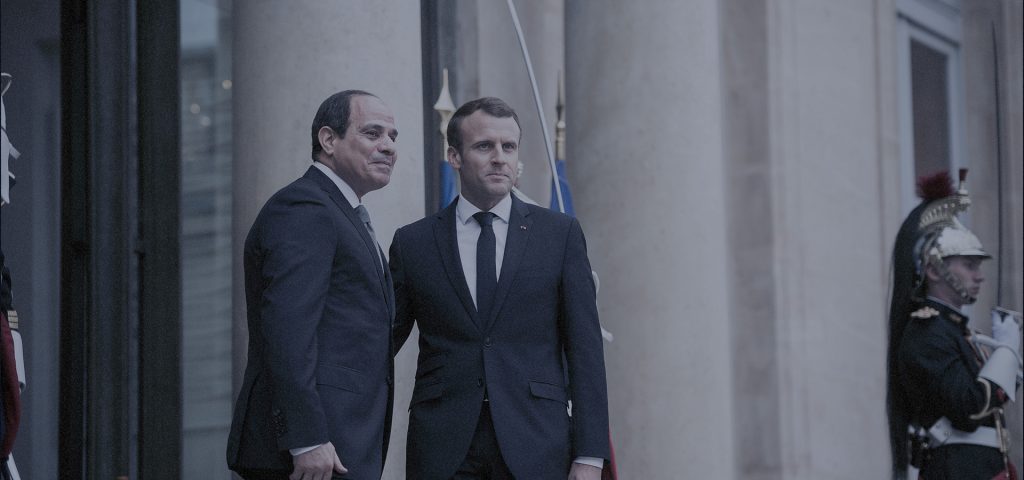
The SGDSN also warns that a parliamentary control over arms exports would also have “consequences for the government, whose different ministries would be exposed”. In 2019, French defence minister Florence Parly was called to account before Parliament over her repeated lies about France’s weapons sales to Saudi Arabia, following revelations by Disclose on the use of these in the war in Yemen. It was a controversy that the government most certainly wants to avoid re-occurring in the future.
Another concern for the executive is the proposal for an eventual rapprochement on the question of arms exports between parliamentarians from different European Union (EU) member states which, MPs Jacques Maire and Michèle Tabarot, describe in their report as an “inter-parliamentary dialogue” that might lead to greater cooperation between member states. For the SGDSN, this “could expose our policies to internal issues that are particular to some of our European neighbours”.
Disclose has seen an email from the French foreign affairs ministry in which it added its own comments on the matter. It underlined that such cooperation between European MPs would be “particularly preoccupying”, and in particular concerning German parliamentarians. “We have no means of controlling the vicissitudes [of German politics],” added the ministry, which warned of the “strong mobilisation, very ideological, of [the German] Parliament on arms exports”.
Those comments illustrate the tensions between Paris and Berlin on the subject of arms exports, notably exposed when Germany imposed a still ongoing embargo on its arms sales to Saudi Arabia after the murder in October 2018 in Istanbul of Saudi journalist and dissident Jamal Khashoggi. President Emmanuel Macron, responding to a question at a press conference that same month during a visit to Slovakia, declared that arms sales “have nothing to do with Mr Khashoggi, one shouldn’t mix-up everything together”, describing an embargo in response to the journalist’s killing as “pure demagogy”.
France’s foreign affairs ministry did not only warn of the dangers of cooperation between French and German MPs on the subject, but also those regarding the institutions of the EU, which it said were “hostile towards our interests in the field of control of sensitive exports”.
The SGDSN document suggests that French MPs would find themselves in a self-made trap if the Maire-Tabarot report recommendations were adopted. “The parliamentarians involved in controlling exports […] would not be able to meet the demands of transparency”, but rather “de facto standing by decisions taken”, it says. In other words, MPs would be wasting their time given they would be faced with the wall of official secrecy concerning areas of information on arms exports.
The last suggestion is that the executive should define “a communication line” to adhere to in face of the media coverage of the MPs’ report and the subsequent reactions from NGOs – a line that is now, in the light of the SGDSN document, much clearer.
On the same topic

French arms
Read the collection