Arms sales to Israel: France’s Thales supplying equipment for armed drones since 2018
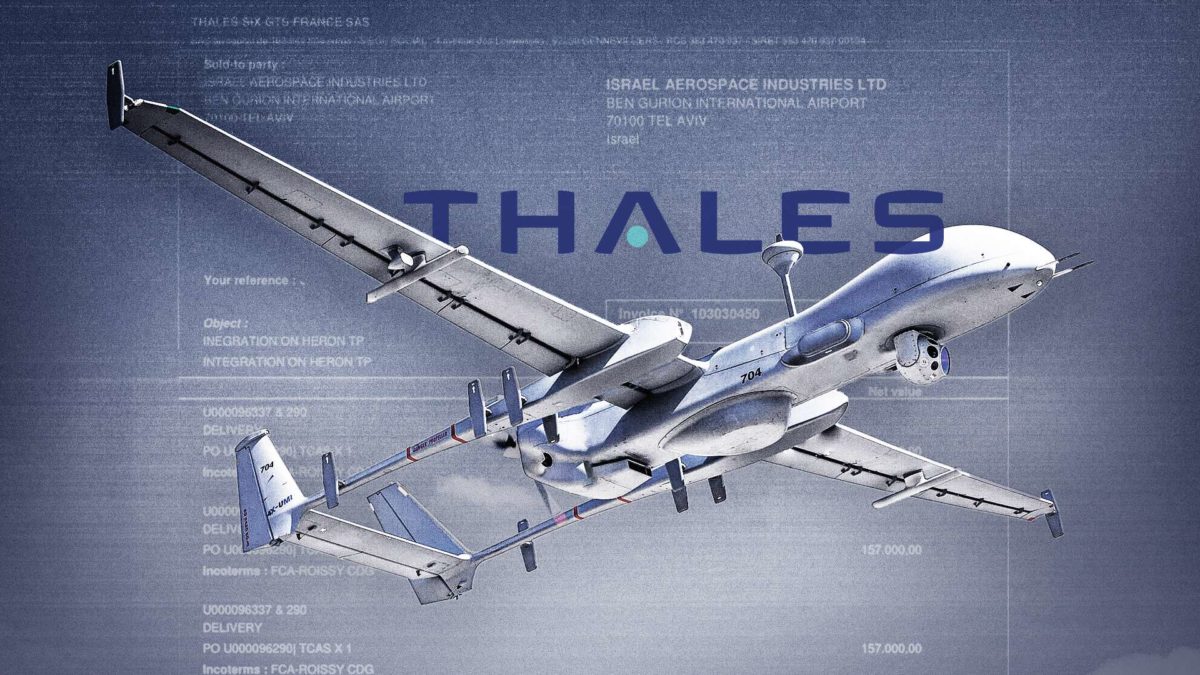
Arms sales to Israel: France’s Thales supplying equipment for armed drones since 2018
The French armament group sold electronic components and communication systems for Israeli drones for €2m between 2018 and 2023, Disclose can reveal based on business documents. The Thales equipment is likely to be used in strikes against Palestinian civilians.
According to its latest progress report, Thales is a model company, an armament multinational concerned about increasing “year after year [its] level of integrity, responsibility and ethical business practices”. This may account for the fact that it is one of the signatories of the United Nations Global Compact who pledge, among other things, “not to be accessory to human rights violations”.
But Thales, in which the French state is the majority shareholder, seems to utterly flout this rule. This is what Disclose’s investigation can reveal based on 12 invoices issued between 2018 and 2023 to two Israeli arms industry heavyweights, Israel Aerospace Industries and Elbit Systems. According to these business documents, Thales sold them operational support systems for €2m for armed unmanned aerial vehicles (UAVs). These are not average drones but Heron TP and Hermes surveillance and attack UAVs, two models which have allegedly been used against Palestinian civilians for almost 15 years.
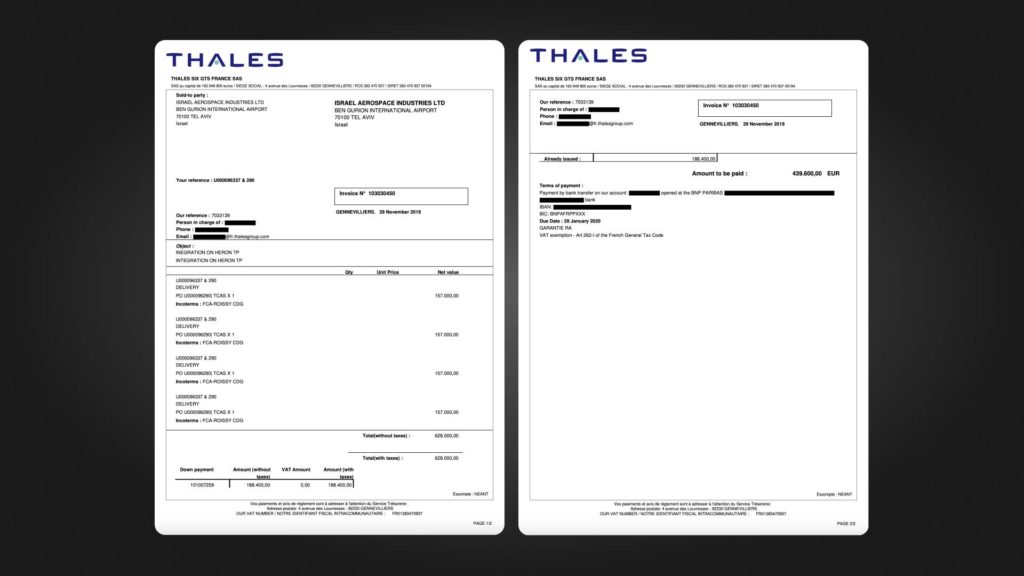
When contacted by Disclose, the company confirmed the sale of components to “Israeli entities” while qualifying the impact of the “airborne communication systems” because, it wrote, they are “not lethal”. Yet transponders and collision avoidance radars are essential to operate devices which may indeed be used to kill. “A radio or radar altimeter is a vital component for a military drone to be able to establish its position in the sky. A radar altimeter is very accurate and therefore it is very good for establishing where the drone is looking,” says Chris Lincoln Johnson, a former officer with the British armed forces and now a consultant on the use of UAVs.
Drones used for violations against Palestinian civilians
On 16 July 2014, four children aged 10 and 11 were playing football on a beach in the Gaza Strip. There was a blast. One of the children collapsed after being hit by a missile launched by the Israeli military as part of the two-month offensive known as Operation Protective Edge. Less than a minute later, the child’s three cousins were shot dead as they fled. Dozens of journalists witnessed the tragedy, including a TF1 crew who filmed the frail and blood-soaked bodies. The footage sparked global outrage. As late as four years later, in 2018, US investigation news outlet The Intercept divulged an Israeli police report which certified that the shots had come from an armed UAV.
During that tragic summer of 2014, even before the start of Operation Protective Edge, the third such offensive after Hamas came to power in the Palestinian enclave, in 2007, the birds of death circled in the Gaza sky for two weeks. Their mission was to “gather intelligence before fighting started,” says a former armed forces commander in charge of a Heron swarm. Using the devices, which are meant to enhance the precision of strikes against military targets, is supposed to limit the number of civilian casualties but the opposite is happening. Among the 2,000 Palestinians killed between July and August 2024, 500 were children. The UAVs are suspected of causing a third of the fatalities, according to a report by Palestinian NGO Al Mezan Center for Human Rights.
As late as the summer of 2022 the Israeli chief of staff officially admitted that armed UAVs had been used, in order, the spokesperson said, to cause “minimal collateral damage”. Over the same period, Israel launched Operation Breaking Dawn: 17 civilians were killed in the two-day offensive, including a child who was visiting his mother’s grave, according to Amnesty International.
The crimes were not detrimental to Thales. On 13 January 2023, five months after Operation Breaking Dawn, the French group issued an invoice for €98,000 for the purchase by Israel Aerospace Industries of a TSC 4000 transponder and equipment to assess its performance. More invoices were issued in June and September 2023 for an order for two radar altimeters and their spare parts, as well as two TSC 2055 transponders. Between 27 February 2018 and 26 February 2021, two transponders and five collision-avoidance radars were sent to Israel Aerospace Industries’ UAV department.
The equipment has been used chiefly to modernise a key part of the Israeli military apparatus, the Heron TP, which Tsahal put into service in 2007. This also applies to the five collision-avoidance radars, which come with a battery of tests and training sessions delivered by Thales engineers. The contracts for Heron UAVs amount to a total of €1.2m or more than half the sales identified by Disclose.
Has the equipment been used for UAVs deployed by the Israeli military? When contacted by Disclose, Thales would not respond. Neither did the armed forces ministry, nor the Secretariat-General for national defence and security. Thales says that both authorised the exports.
Equipment for €1.2m for Heron TP drones
Palestinians first saw these drones appear, with their distinctive long wings and rectangular tail, at the time of Operation Cast Lead in the winter 2008-09. Civilians were among the first targets of the redoubtable device which can fly continuously for 40 hours and carry up to a tonne of missiles. For instance, “high-precision missiles launched from helicopters and UAVs” killed children who were playing on flat roofs as well as rescuers busy caring for injured people, according to Amnesty International. The UN also documented the slaughter of worshippers outside a mosque. During the offensive, infantry units typically entered Gaza preceded by UAVs at a distance of 450 metres. The UAVs were used to “clear the area and to guide troops by relaying advice regarding safe routes,” Michele Esposito, an associate researcher at the Institute of Palestine Studies told to Airwars. Over a fortnight of fighting, 1,400 people were killed on the Palestinian side, 13 on the Israeli side.
Over the years, UAVs fitted with missiles or intelligence software have become an integral part of war crimes committed by the Israeli military. As technologies are upgraded, impunity is becoming even more blatant. In May 2021, the Heron TP fleet was involved in the slash Operation Guardian of the Walls, dubbed the “first AI war”. During the 11-day attack, schools, hospitals, businesses and residential buildings located “away from military targets” were bombed continuously, according to Israeli-Palestinian site +972. “This is not a mistake, these are not exceptional cases. It is policy,” Israeli NGO B’Tselem commented.
The war that started on 13 October 2023 is no exception. Until the 15 January 2025 ceasefire, Heron TP UAVs were deployed continuously alongside special and infantry forces. The bombings resulted in 48,000 casualties, including more than 14,000 children, according to Unicef.
Transponders for Hermes killer drones
The year 2023 was also a year of record exports. In addition to deliveries to Israel Aerospace Industries, the Thales group landed a contract for close to half a million euros with Elbit Systems for a consignment of eight TSC 4000 IFF transponders. The components are used for Hermes 900 armed UAVs, as revealed by Disclose in an investigation published in June last year. Although killer drone swarms operate 24/7 in Gaza, at a time when NGOs and international organisations have been documenting multiple war crimes committed by the Israeli military in schools, hospitals and refugee camps, nothing is preventing the contract from being carried out.
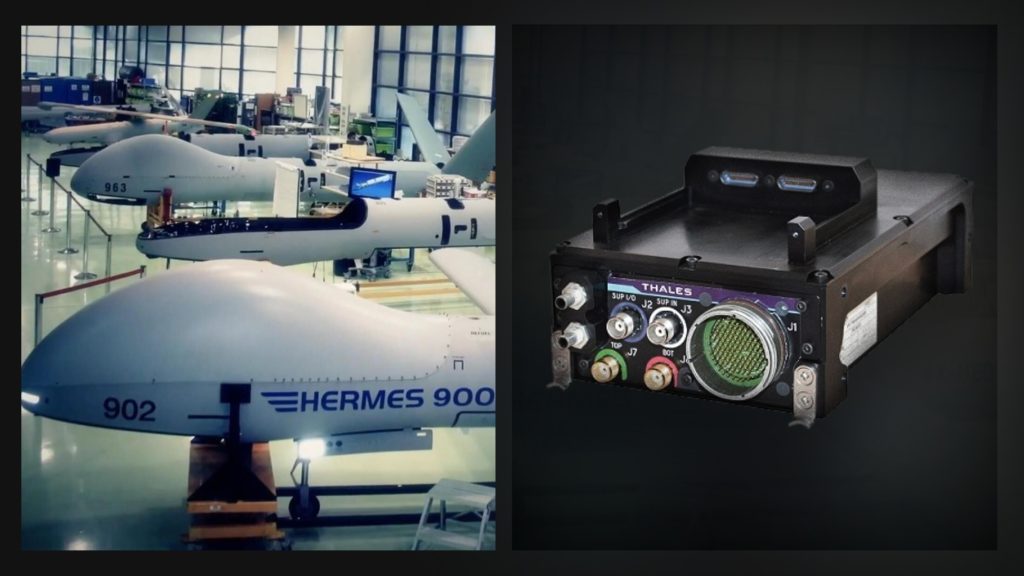
In January 2024, Elbit Systems took delivery of the two transponders. According to Thales, the final consignee was not the Israeli military, a regular Elbit Systems client, but third countries “not under EU sanctions”. The shipment of the other six communication systems is believed to have been blocked by the French authorities, according to our information. The French firm told Disclose that it now “complies strictly with the rules” and that it has delivered “no lethal equipment and no equipment making it possible for a lethal system to function” in Israel “since 7 Octobre 2023”.
Yet something should have prompted Thales to display increased vigilance long before 2023. Elbit Systems sold equipment to Thales for at least €200,000 between 2019 and 2020, and Israel Aerospace Industries sent Thales electronic parts for close to €310,000 in 2020. In other words, the two Israeli companies also supply products to Thales. The French group demands from all its partners that they apply “the human rights principles” of the UN Global Compact. Do Elbit Systems and Israel Aerospace Industries qualify for a derogation from the rule? When contacted, Thales’s PR department did not respond. Neither did its two suppliers.
The French justice system could now hold the European defence leader to account. Clara Ernst Mollier, a lawyer with Ancile*, says that Thales’s deliveries in Israel “raise questions regarding its implementation of its duty of care obligations”. Under a 2017 law, the group needs to prevent human rights abuses in its supply chain, failing which it may be prosecuted.
*Joseph Breham, a lawyer with Ancile, is a member of the Supervisory Board of Disclose
Investigation: Ariane Lavrilleux
Editing: Mathias Destal
Translation from French: Béatrice Murail
Composite image: Caroline Varon