Decathlon’s “secret project” to keep doing business in Russia
Decathlon’s “secret project” to keep doing business in Russia
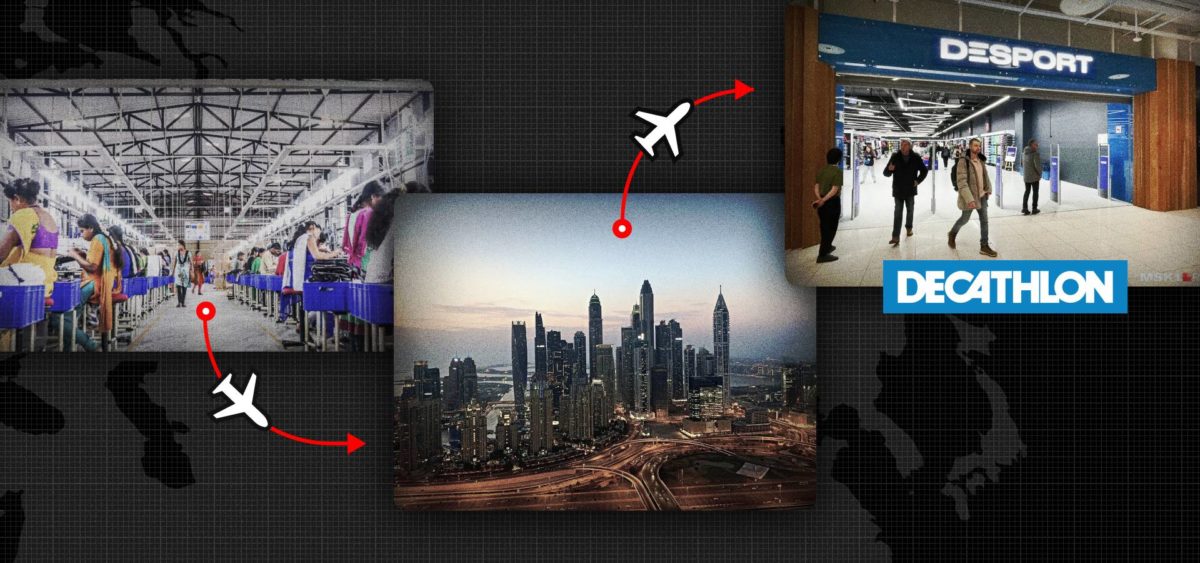
A shell company in Dubai and a subsidiary in Singapore: French sports retail giant Decathlon has set up an opaque system to continue selling its products in Russia, although it announced its departure from the country. Internal documents seen by Disclose reveal that the multinational has pocketed at least $12m thanks to this secret contract.
The departure was brutal. On 29 March 2022, a month after the war started in Ukraine, Decathlon announced it was putting an end to its activities in Russia. International pressure was mounting on the French sports retail giant, as with other Western brands, to leave the Russian market quickly. The firm’s departure was formalised in October 2023, with the sale of its 60 stores to a local buyer, the Desport brand. Officially, Decathlon’s presence in Vladimir Putin’s Russia was history. Officially only.
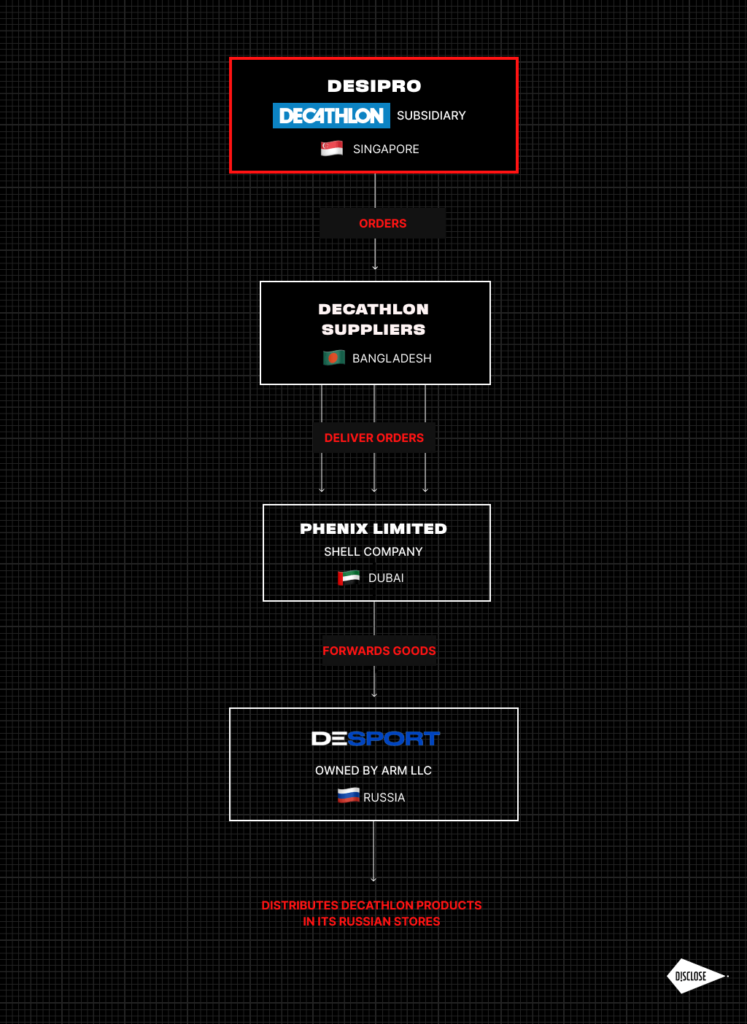
For several weeks now, the French multinational has continued to discreetly supply the Russian market with products bearing its flagship brands: Quechua, Wedze and Kalenji. After conducting an investigation based on internal company documents, open-source videos and testimonies from several former employees, Disclose can reveal that Decathlon has set up a large system to conceal its exports under a supply contract with Desport for at least $12m. At the heart of the move, on the fringes of legality, are the French group’s top leaders, a shell company domiciled in Dubai and a subsidiary of the brand based in Singapore.
Using the word ‘Russia’ was banned
“I heard that Decathlon wanted to keep selling its products in Russia in the summer of 2023,” says a source who recently left the company. “I immediately realised that this was a secret project.” Back then, says the former employee, who was in contact for a long time with Decathlon’s subcontractors in Asia, “we were not allowed to talk about it with our colleagues. For those of us in the know, using the word ‘Russia’ was banned. We had to use a code name: Sports_R.”
The “secret project” with Russia was set up quickly, as evidenced by an email sent in September 2023 by a Decathlon production manager in Europe. In the email, which Disclose has seen, the executive tells colleagues enthusiastically about the forthcoming signing of “a supply contract with the new [Russian] buyer”. The confidential agreement was expected to be worth $12m, for 1.2m products to be sold as quickly as possible in Desport stores.
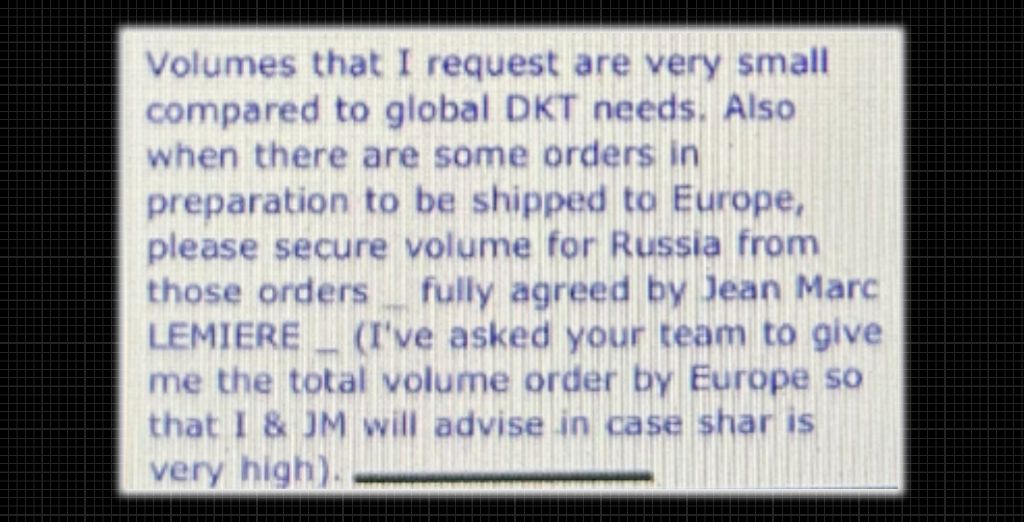
To be able to supply such large quantities without being seen, and over a short period of time, the sports group developed a strategy revolving around two tricks. The first: divert some products initially intended for European stores, as evidenced by the email sent in September 2023: “For orders meant to be sent to Europe, please put some aside for Russia”. The production manager added that he had got “full support from Jean-Marc Lemière”, who is none other than the group’s chief financial officer. Disclose contacted Jean-Marc Lemière but received no response.
A shell company in Dubai
The second trick is more sophisticated and much more opaque. To be able to fulfil its Russian contract, Decathlon resorted to a Singapore-based subsidiary, Desipro. With its help, the group ordered goods urgently from its Asian suppliers. But there was a problem, says a former Decathlon employee in Asia. “Because of the war in Ukraine, we could not ask our subcontractors to export these products directly to Russia. The shipments would have been stopped by local authorities.” The sports retail giant, clearly not averse to stunts, then demanded from its Asian partners that they fly their consignments to Dubai. On arrival, a company called Phenix Limited took delivery of the cargoes, as shown on an invoice for Quechua fleece jackets that we have seen.
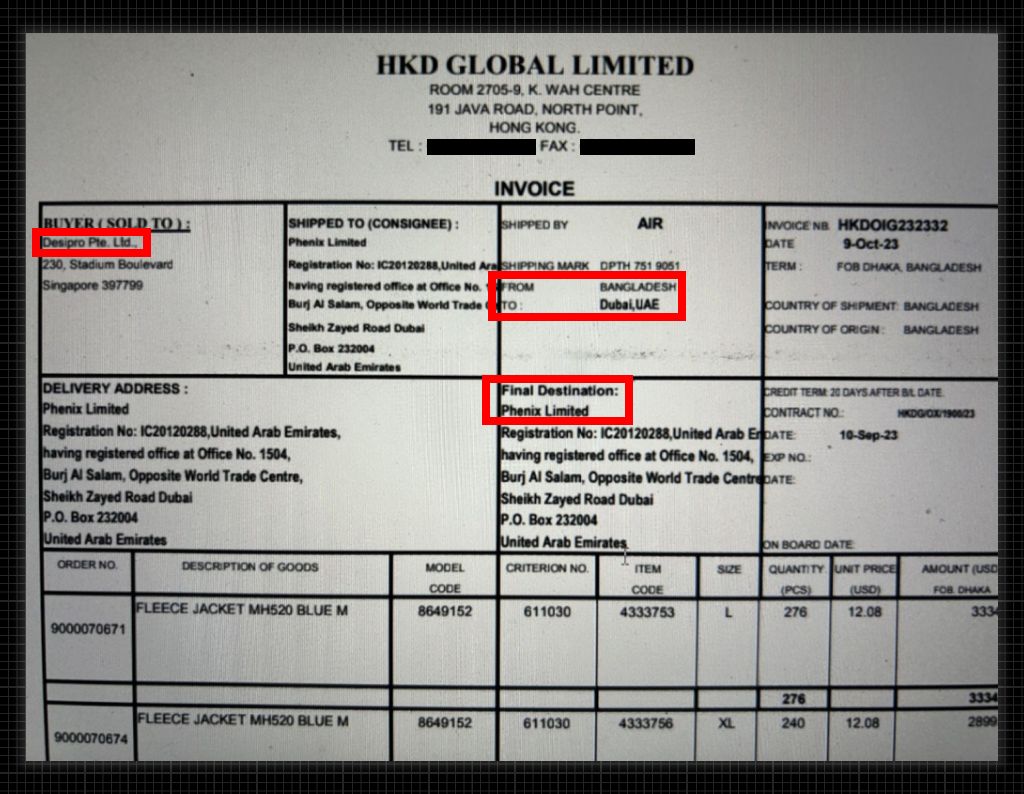
“Dubai is just a decoy,” a former Decathlon employee told Disclose. Phenix Limited has all the hallmarks of a shell company: no webiste, no recorded employees on the Internet and only one contact listed on the Dubai trade register: that of Sun Dubai, a firm specialising in the creation of offshore companies. In fact, “containers of Decathlon products sent from Bangladesh never left Dubai airports,” our internal source adds. “They were immediately sent on to Moscow.”
Flying the goods emits a large amount of CO2. Decathlon is supposed to fly products on an exceptional basis only — 0.4% of its goods are flown to their destination, according to the company. In an internal logistics table dated October 2023, Disclose identified references for Kalenji running jackets, Wedze ski jackets and Quechua trousers and shoes, all flown from Bangladesh to Russia, via Dubai. Tens of thousands of goods are involved.
A business on top form
The first Decathlon products landed on Russian soil in early November. “Despite all the difficulties, the first six deliveries have gone through customs and arrived at the CSC [Continental Supply Centre] in Moscow,” a thrilled Desport employee, formerly with Decathlon Russia, wrote in an email to former colleagues on 2 November.
The next day, one of the group’s logistics managers confirmed in a separate message that 511 cubic metres of goods — the equivalent of eight large containers — “have been sent from Bangladesh to Russia”. He added that “the import team wanted to test the process” and that, given the success of the operation, “supplies are now on the way up”.
A statement that clashes with the group’s official position. When Disclose contacted Decathlon about the continuation of trade with Russia, the company stated that it is “doing everything possible to put an end to the resale of [its] products on Russian Federation territory”. This is a reference to its clothes being sold illegally by individuals on Russian e-commerce sites. But no mention of the goods that the group itself ships to Vladimir Putin’s country. Decathlon did not respond to our request for further information.
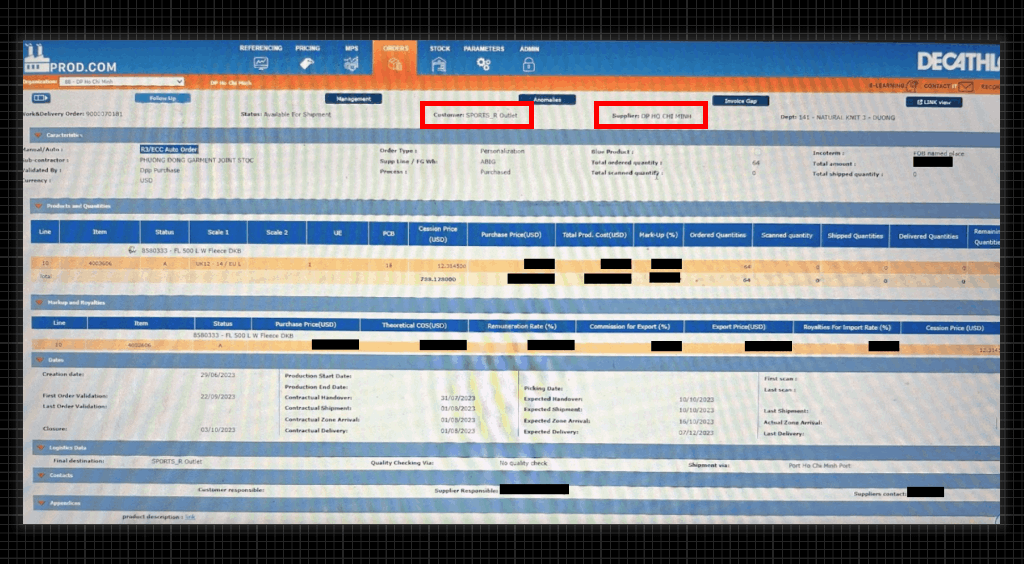
However, our investigation shows that the scheme, designed to conceal deliveries to Russia, does not rely on Bangladesh only. Screenshots of some of the group’s logistics databases show that since last October, its offices in Vietnam and China have also been scheduling consignments to Sports_R, the code name for Desport stores. It is in these three countries that Decathlon manufactures most of its products, which are distributed under 36 sub-brands.
Are these deliveries legal or illegal, given the international sanctions against Russia? “It is a grey area, at the very least,” a French corporate compliance expert told Disclose. He added that “the increasing complexity of supply chains, between Singagpore and Dubai, could be tantamount to circumventing sanctions”. Kevin Lefebvre, an economist with the Centre d’études prospectives et d’informations internationales [Centre for Prospective Studies and International Information] told Disclose without commenting specifically on Decahtlon that “86% of textile products exported by France to Russia before the war in Ukraine could not have left the country now because of EU sanctions”.
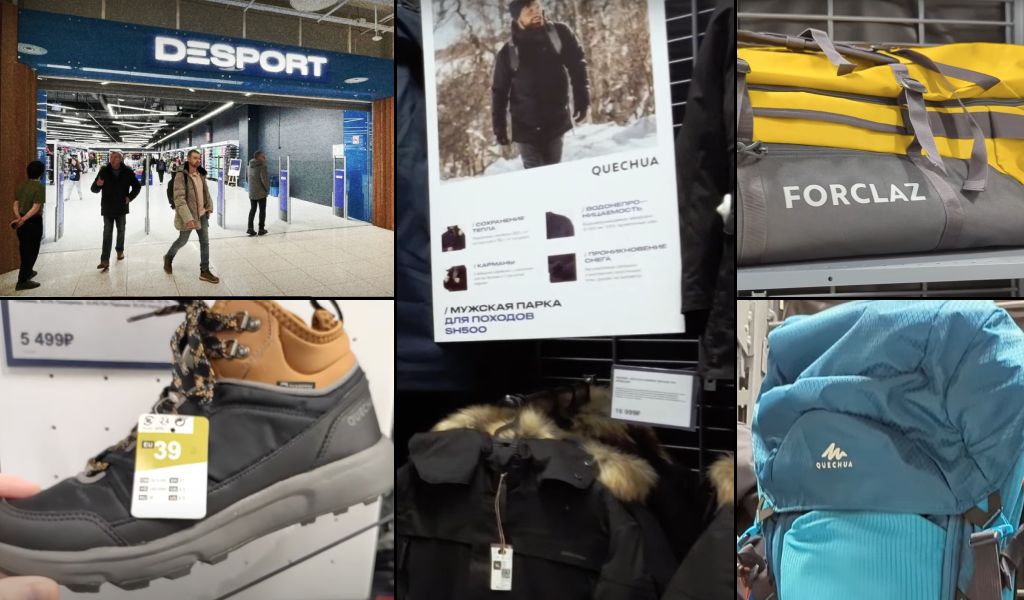
On 25 November, the first Desport store opened on the outskirts of Moscow. The shop sign – white capital letters on a blue background – is very similar to Decathlon’s. Customers were greeted by applause and cheers from the store’s 70 employees. They formed a guard of honour for the occasion, as shown in a video released by Desport. The brand, which has since opened 16 other stores, in Moscow and Saint Petersburg, is aiming to replace Decathlon stores with 28 superstores by the end of December.
Quechua, B’twin, Rockrider, Wedze, Arpenaz, Forclaz: the Decathlon brands can be seen in several videos posted by Russian Internet users on the VKontakte social network, as they wander along the aisles of Desport stores. Lifting the label on a pair of Kalenji trousers, one of them exclaims: “Made in Bangladesh!”.
Reporter: Pierre Leibovici
Editor: Mathias Destal
Translator: Béatrice Murail
This investigation is copublished on Mediacités, a local independent investigative news outlet based in Lille, Lyon, Nantes and Toulouse
This investigation is free of charge, thanks to you
Because information is a public good, Disclose offers you all its investigations free of charge, without subscription or advertising. This model is unique in France for an investigative news outlet.
But it’s only possible on one condition: that readers like you support our not-for-profit newsroom. Donations to Disclose are eligible for a 66% tax reduction in France. So a donation of €100 will only cost you €34. Thank you for your support!


On the same topic
