Despite their climate commitments, insurers AXA and SCOR support U.S. shale gas
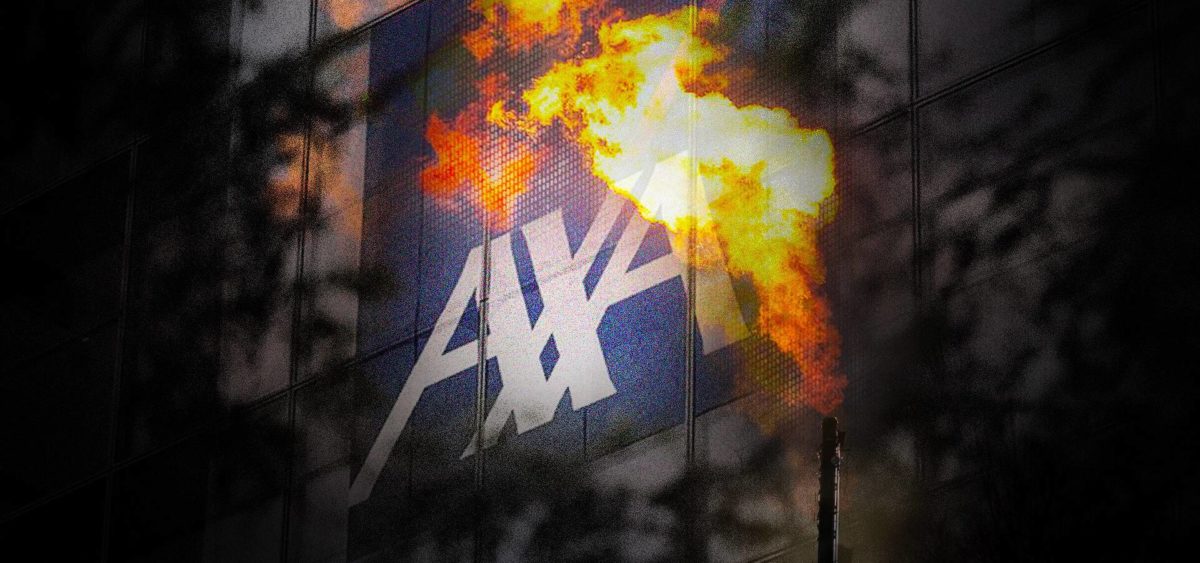
Despite their climate commitments, insurers AXA and SCOR support U.S. shale gas
Insurance companies AXA and SCOR aim to be leaders in the fight against climate change and are stepping up their commitments. However, insurance certificates obtained by Disclose, in partnership with Rainforest Action Network, Public Citizen and Reclaim Finance, show that the two French insurance giants cover several liquefied natural gas terminals in the United States linked to the highly polluting shale gas industry.
“Managing the inevitable”. Since the start of 2024, insurance company AXA has been on the campaign trail, telling companies and private individuals that it is by their side to address the consequences of climate change and to support them as they adapt. What with the recent flooding in northern France, hurricanes hitting the United States with increasing frequency, drought and forest fires, “time is running out,” as the leading French insurer wrote in its “adaptation guide” released on 2 February. In the 40-page booklet, the company reminds us that “current greenhouse gas emissions are leading us towards global warming that will keep getting worse”. On the same day, Thomas Buberl, the group’s CEO, posted a message on social media in which he stressed that it was important for companies to “reduce CO2 emissions while adapting to the impact of climate change”.
And yet, despite its avowed determination, the insurer with a €102bn turnover in 2022 is one of the major contributors to climate change, as shown by insurance contracts that were confidential until now. The documents, obtained by Disclose’s partners, American NGOs Rainforest Action Network and Public Citizen, reveal that the French group insures one of the largest liquefied natural gas (LNG) export terminals in the United States called Cameron LNG. Under this contract, AXA covers damage for over $5m, of the $100m required. Risks, including terrorism-related risks, are covered from June 2023 to June 2024. Other insurers involved in the project include Germany’s Allianz and Swiss Re of Switzerland.
AXA, a pyromaniac firefighter when it comes to climate
“It is schizophrenia,” an internal source at AXA told Disclose. They say that this double game can be explained by the fact that “the reputational risk associated with gas is still very limited”. This is in constrast to coal, about which AXA has widely communicated its exit strategy by 2030. Regarding LNG, a profitable sector with fairly low risk, AXA has decided to keep a low profile. Not a word from its communication department. Nothing at all. Yet LNG is far from being a clean energy, even less so when it is produced in the United States.
American LNG, exported around the world via methane terminals such as Cameron LNG, comes largely from shale gas. Almost 80% of the gas produced in the United States is derived from shale. It is extracted through hydraulic fracturing, a method banned in France since 2011, partly because of its impact on the climate as producing the gas releases high levels of methane, a gas 80 times more polluting than CO2. Clark Williams-Derry, an energy finance analyst at the American Institute for Energy Economics and Financial Analysis (IEEFA), says that things are quite clear: “LNG has become the engine for new gas infrastructure in the U.S. – not just fracking and drilling, but pipelines as well”.
“All it would take is for a few big names in insurance to commit to withdrawing from these projects to curb the ability of companies to insure projects that are damaging the climate”
Ariel Le Bourdonnec, Reclaim Finance
When contacted by Disclose, AXA acknowledged that its “energy policy does not include any restrictions on its insurance activities for LNG terminals,” while emphasising its various commitments in the fossil fuel sector, in particular the exclusion “of companies where more than 30% of gas production comes from shale gas”. The insurer seemed unperturbed by this contradiction in terms. They invoked business confidentiality to avoid sharing information about “the identity of customers […] and individual projects”.

By insuring the Cameron LNG terminal, the AXA group cannot be unaware that it is actively participating in the shale gas boom in the United States. Production is in the hands of, among others, TotalEnergies, which has some 1,700 active shale gas fields in Texas. The company, which boasts of being the second largest producer of LNG in the world, owns 16.6% of the terminal. Also, it is hard to argue that LNG is a transitional source of energy. For example, Cameron LNG’s accidental emissions between 2019 and the end of 2022 would be equivalent to the emissions from 2,000 cars over a year, according to research by environmental group Louisiana Bucket Brigade.
“AXA and its competitors are hiding behind the large number of players involved in LNG terminals to shirk their responsibilities,” laments Ariel Le Bourdonnec, an insurers campaigner at Reclaim Finance. “All it would take is for a few big names in insurance to commit to withdrawing from these projects to curb the ability of companies to insure projects that are damaging the climate.”
The Gulf of Mexico, an LNG hub in danger of collapsing
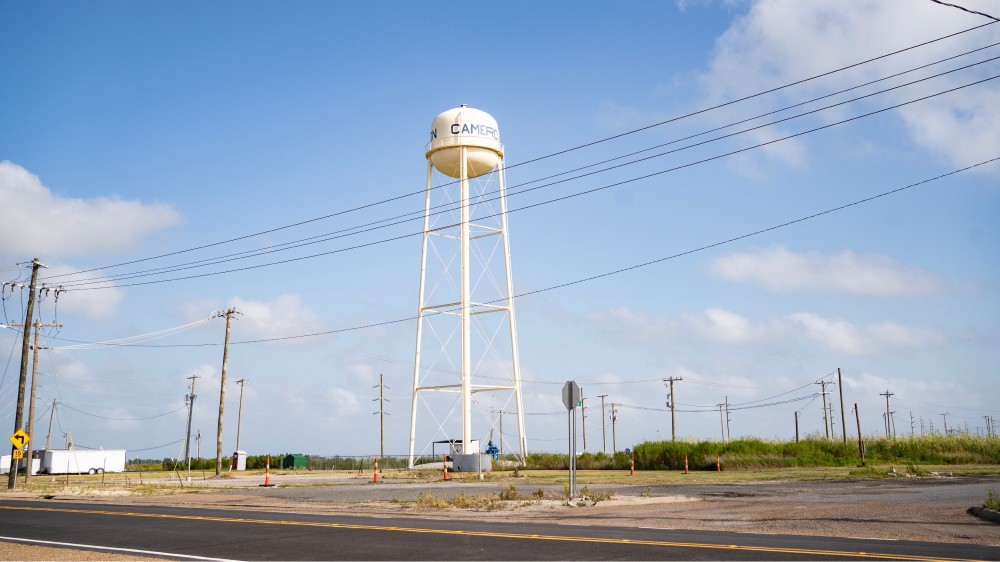
For an earlier investigation into TotalEnergies’ shale gas scandal in the United States, Disclose visited the Cameron LNG site in Louisiana. To get there, you drive down the only county highway between Lake Charles and the Gulf of Mexico. For a long time, the area was protected from hurricanes by its wetlands, but it has been turned into an LNG export hub and is now in danger of collapsing, say researchers at Tulane University of Louisiana, because of the huge canals dug by the oil and gas industry to transport LNG to the coast. The area is also hit hard by climate change and increasingly violent storms such as Hurricane Delta in 2020 with gusts of 160 km/h. Churches had their walls ripped off, houses only had their foundations left and businesses were abandoned. Last summer, three years after the hurricane, the destruction was still very much in evidence.
In 2022, more than 60% of cargo ships exporting LNG from the United States left from the Louisiana coast. Some of these ships supply French consumers directly: since AXA signed the contract in the summer of 2023, at least 19 tankers have reached France from the Cameron LNG site, according to data from the U.S. Department of Energy.
Some 4,000 km from the Gulf of Mexico, on the West coast of the United States, another LNG facility enjoys the discreet support of French insurer AXA, as evidenced by other contracts obtained by Disclose and its partners: the Tacoma LNG terminal, located in the eponymous city, some 200 km from Canada. The Puyallup Native Americans have protested repeatedly against the industrial site, which they say puts their community’s fishing resources and health at risk. According to a group of U.S. environmental organisations, the terminal, which has been in operation since 2022, could also lead to “increased transportation and production of fracked gas”. The gas site facilities are insured for $650m. AXA, via its British subsidiary AXA XL Insurance Company UK Ltd, has provided close to $36m in insurance coverage, or 5.5% of the required insurance capacity in 2023.
Tacoma LNG does not export U.S. gas but supplies LNG-powered ships such as Tote Maritime’s two huge cargo ships which leave Tacoma for Anchorage, Alaska twice a week, carrying foodstuffs, consumer goods and up to 250 vehicles per shipment.
Tacoma LNG does not export U.S. gas but supplies LNG-powered ships such as Tote Maritime’s two huge cargo ships which leave Tacoma for Anchorage, Alaska twice a week, carrying foodstuffs, consumer goods and up to 250 vehicles per shipment.
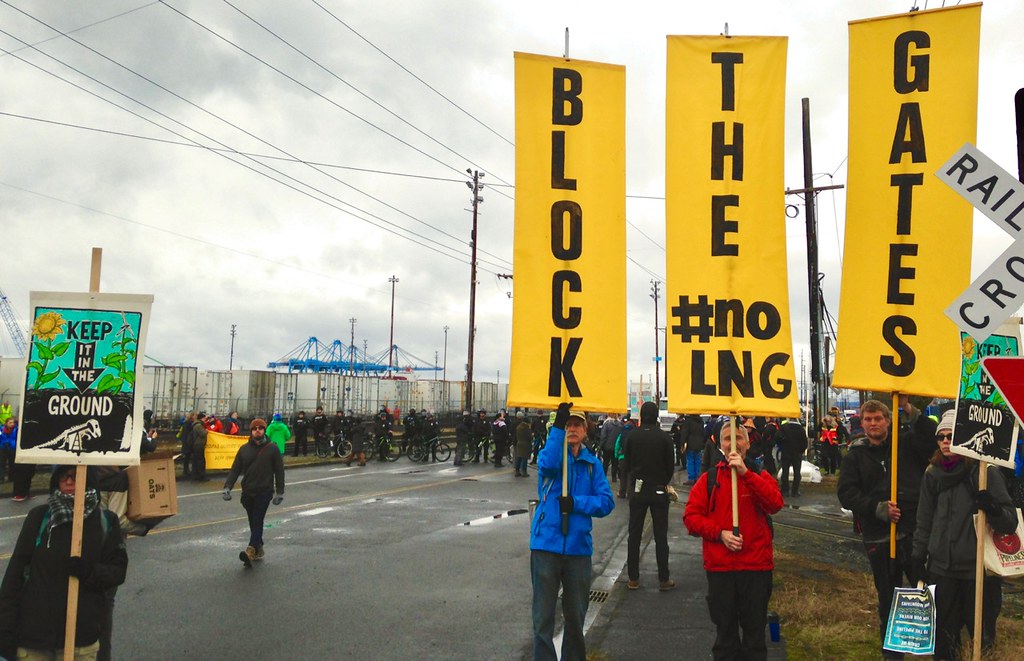
Last January, Tacoma LNG had to withdraw its application to expand its facilities after local residents mobilised and several environmental groups, who saw the project as a “climate disaster,” raised the issue with the relevant authorities. Greenhouse gas emissions from LNG-powered ships are reported to be 70%-82% higher than those from conventional heavy fuel, according to thinktank International Council on Clean Transportation (ICCT).
AXA is not the only French insurer to make moves into the extremely polluting American LNG industry. According to documents seen by Disclose, reinsurance giant SCOR, the world’s fifth largest in its field, also covers Tacoma LNG, together with AXA. As a reinsurance company, SCOR provides cover for insurers. In other words, insurers transfer part of their risks to reinsurance companies to avoid having to bear particularly costly events alone. In Tacoma, SCOR provides reinsurance cover for the facility for $22.75m.
And yet in 2023, the industry heavyweight also stepped up its climate commitments. It announced in particular that it would no longer cover new gas fields. The French group has also pledged for several years to stop investing in companies producing shale gas. Its support for an LNG terminal largely powered by the raw material raises questions as to how serious these announcements may be, especially as the company’s name comes up in another U.S. gas project. This time, SCOR is one of the insurance companies covering facilities at the Gulf LNG terminal in Mississippi. The terminal, which is dedicated to gas imports, is expected to be expanded soon and to be converted in order to export LNG, as per the wishes of its owner, energy giant Kinder Morgan. Of the $750m in required insurance capacity, the share of the French group is not specified in the contracts that we have analysed. When contacted by Disclose, SCOR only answered: “We do not share information about our customers and individual projects”.
While French insurance companies assist one of the most damaging industries to the climate on the other side of the globe, their longtime customers in France feel helpless. In an opinion piece published at the end of 2023, a group of mayors of small towns accused “insurers of disengaging” and of compelling them to self-insure at their own expense. The reason given by insurers? The increase in natural disasters caused by climate change.
Investigation: Alexander Abdelilah
Edition: Mathias Destal and Pierre Leibovici
Translation: Béatrice Murail
This investigation is free of charge, thanks to you
Because information is a public good, Disclose offers you all its investigations free of charge, without subscription or advertising. This model is unique in France for an investigative news outlet.
But it’s only possible on one condition: that readers like you support our not-for-profit newsroom. Donations to Disclose are eligible for a 66% tax reduction in France. So a donation of €100 will only cost you €34. Thank you for your support!