France and six European states unite to authorise the spying on journalists
France and six European states unite to authorise the spying on journalists
France, Italy, Finland, Greece, Cyprus, Malta, and Sweden aim to undermine the first European law aimed at protecting freedom and independence of media in Europe. According to documents obtained by Disclose, in partnership with Investigate Europe and Follow the Money, these seven countries actively advocate for authorizing surveillance of journalists in the name of “national security”.
The tug of war is coming to an end. For over a year, a bill designed to protect media freedom in Europe, the European Media Freedom Act, has been the subject of intense debates in Brussels and Strasbourg. Within this document aimed at ensuring the independence, freedom, and pluralism of the media, one article stands at the heart of tensions between the member states and the European Parliament: Article 4, concerning the protection of journalistic sources, considered as one of the “basic conditions for press freedom” by the European Court of Human Rights. Without this protection, “the vital public-watchdog role of the press as guardian of the public sphere may be undermined.”
Disclose, in partnership with the collective of journalists Investigate Europe and the media Follow the Money, has managed to penetrate the closed-door negotiations. Our investigation unveils the details of fifteen months of negotiations that could lead to a final text on December 15, 2023, after a third round of discussions between the EU Council, the Parliament, and the European Commission. These documents (summarised at the end of this article) reveal the repressive intentions of the French government against the press, actively supported by the far-right Italian government and the authorities of Finland, Cyprus, Greece, Malta, and Sweden.
Widespread surveillance
To understand the ongoing wrestling, we must go back to September 16, 2022. At that time, the European Commission introduced a bill on media freedom. In its Article 4, the text prohibits the use of spyware against journalists and media except in case of ten types of “serious crimes investigations” (terrorism, rape, murder — see box at the end of the article). These technologies, enabling the interception of emails and secure messages, could also be used on a “case-by-case basis, on grounds of national security”.
This was inconceivable for France, which, in an internal document to the EU Council on October 21, 2022, obtained by Disclose and Investigate Europe, stated that it “refuses that issues related to national security would not be addressed within a derogation.” Elisabeth Borne’s government, represented by its cultural advisor, demanded the addition of an “explicit exclusion clause” to the prohibition of monitoring journalists. In other words, France wants to obstruct the work of the press when it deems it necessary in the name of national security. This demand eventually gained support from the silent majority of other member states.
On June 21, 2023, 25 out of 27 EU member states adopted a new version of the law at the Council of the European Union, and triggered outcry of 80 European media organizations and associations. While the text forbids forcing journalists to reveal their sources, conducting searches on them, or spying on their electronic devices, it expands the leeway for intelligence services: spyware could be deployed in investigations related to a list of twenty-two additional offenses punishable by 3 to 5 years of imprisonment. These offenses include sabotage, counterfeiting, corruption, or infringement of private property. Journalists working on these subjects and having relationships with sources targeted by such investigations could therefore be subjected to police surveillance.
Furthermore, the last sentence of the text introduces a very broad derogation: “This Article is without prejudice to the Member States’ responsibility for safeguarding national security”. In other words, surveillance would become legal if a Member State deems its national security threatened. “Any national security reason could be enough to pursue or monitor a journalist”, explains Christophe Bigot, a specialist in press law in France. This could happen, for example, following an article about a restaurant violating lockdown measures based on anonymous sources.
Spyware on smartphones
According to our information, it was the French Ministries of Interior and Defense that requested the derogation. The latter, after assuring us it was not involved in negotiations, clarified its stance: the French position would “preserve the legal framework of French intelligence, which is both protective and balanced, and provides for a general regime of reinforced protection for certain ‘protected’ professions, including journalists.” Such operations are currently conducted “under the control of an independent administrative authority”, adds the Ministry of Defense, namely the National Commission for the Control of Intelligence Techniques composed of parliamentarians and magistrates. The French Ministry of Culture—officially in charge of the negotiations—insists that “this margin of appreciation left to the Member States in no way means that they can disregard respect for fundamental rights and the European Convention on Human Rights.”
In recent years, Greek, Spanish, Bulgarian, and Hungarian authorities have already invoked their national security to justify using spyware such as Pegasus and Predator against investigative journalists.
Faced with the risk of abuse, the European Parliament called to order the Member States. On October 3, two-thirds of the Members of the European Parliament adopted a legislative proposal foreseeing much stricter regulation of surveillance on journalists. Thus, in this alternative version of Article 4 of the European Media Freedom Act, the communications of journalists can only be intercepted or their phones infected with spyware if specific conditions are met. Intrusion should not result in accessing journalistic sources; it must be justified on a “case-by-case” basis in investigations into serious crimes such as terrorism, rape, or arms trafficking, and should not be related to the professional activities of the media. Additionally, an “independent judicial authority” must give authorization and perform “regular oversight” afterward.
“Red Line”
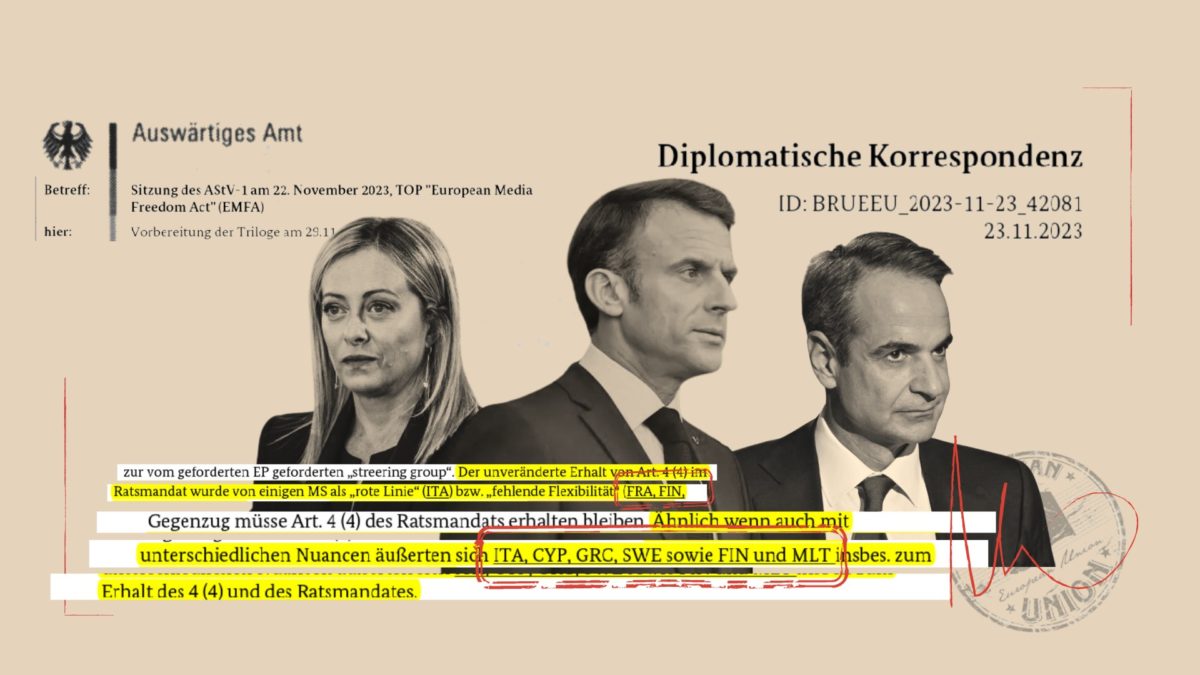
This was without counting on the French government and its six European allies who continue to strongly advocate, as revealed in a summary of a meeting of the EU council on November 22, 2023, obtained by Disclose and its partners. In this document drafted by German senior officials, it is learned that Italy considers maintaining the paragraph on national security (in Article 4) as “a red line”. This means it vehemently opposes its removal. France, Finland, and Cyprus state they are “not very flexible” on the issue. As for Sweden, Malta, and Greece, their representatives claim to be on the same line, “with a few nuances”.
Even though these seven states represent only 34% of the European population, this minority can block any compromise by allying with Hungary’s Viktor Orban, who rejects the entire text (deeming it too liberal for his taste). For the law to be adopted, the supporting states must represent 65% of the population. Hence, the majority of other governments have adopted the tough French-Italian line to salvage the text. Only Portugal dared to criticize this staunch defense of the exception in the name of national security. Contacted, the Portuguese representation in Brussels expressed being “concerned about the future impact that this provision could have, not only on the freedom to exercise the profession of journalist but ultimately on European civil society.”
Smoke and mirrors
Familiar with the art of compromise, the French government and its allies now claim to be in favor of adding “safeguards required by the European Parliament to protect journalists’ sources”, as read in the November 22, 2023 summary. Namely, the obligation to obtain “approval from a judicial authority” before compromising the protection of sources and the establishment of a mechanism afterward “for regular control of surveillance technologies”. However, according to lawyer Christophe Bigot, this intervention of a judge beforehand would be a mere “paper change since it would require the approval of the liberties judge, which is already the case in preliminary investigations where there are searches of journalists or editorial offices”. A formality mostly granted, as was the case for the search by the DGSI and the police custody of Disclose journalist Ariane Lavrilleux on September 19.
Until now, one institution has restricted the security excesses of states: the Court of Justice of the European Union (CJEU). It has repeatedly emphasized that states cannot wield the concept of national security indiscriminately to violate European laws. In October 2020, the judges, for instance, prohibited French authorities from forcing internet providers to retain all data of internet users outside the scope of an investigation. Reason being: the directive protecting privacy and electronic communications prohibits it. Since this legal setback, which set a strict framework, France and its allies want to avoid further similar decisions and maintain flexibility regarding surveillance of journalists.
Will the Parliament accept the compromise proposed by the Council of the European Union, pressured by seven of its Member States? Will it yield to preserve a law that, otherwise, includes advancements regarding the independence of public television and newsrooms in general?
From both the right and the left, parliamentarians involved in the negotiations consider the removal of the mention of national security as a prerequisite. This is the case for Geoffroy Didier, a member of Les Républicains and co-rapporteur of the text. He solemnly asks “Emmanuel Macron and the French government to renounce their plan to legally spy on journalists.” By December 15, there are only three days left for the parliamentarians to convince the Spanish presidency of the EU and the governments. Three days for a press freedom law not to cause its own demise.
Ten Key Dates in Negotiations on the Media Freedom Act
- September 16, 2022: Presentation of the European Media Freedom Act
The European Commission introduces a bill on media freedom. Its Article 4 prohibits the use of spyware against journalists except “on a case-by-case basis, on grounds of national security”, and “serious crime investigations of media service providers or, if applicable, their family members, or their employees or their family members , their employees, or family members on ten serious forms of crime” (namely terrorism, human trafficking, sexual exploitation of children, illicit trafficking in weapons, murder, organ trafficking, kidnapping, organized robbery, rape, and crimes within the jurisdiction of the International Criminal Court). - October 21, 2022: France Wants to Monitor Journalists
In an internal document to the EU Council, where seat the governments of the 27 Member States, French authorities “request the addition of an explicit exclusion clause and refuse to have issues related to national security addressed within a derogation”. France also demands the ability to detain, monitor, or search media outlets in case of “overridding requirement in the public interest”. - March 10, 2023: EU Presidency Tones Down French Zeal
The EU Council’s secretariat, then chaired by Sweden, proposes to prohibit the use of spyware except when justified “on a case-by-case basis, on grounds of national security”, and only in investigations into a list of then “crime” such as terrorism, rape, or arms trafficking. - April 17 and 25, 2023: France Insists and and Puts Pressure
The French government sends two guidelines to French MEPs to defend its repressive position (here and here). It explains its desire to “remove the definition of ‘serious crime’” (limited to ten types of crimes) as it would fall under the “procedural autonomy of Member States”. France wants a free hand to spy on journalists. - June 21, 2023: France Gets Its Way in the EU Council
Almost all EU Council Member States (25 out of 27) adopt a bill allowing the deployment of spyware against the media and their teams in case of an “overriding requirement in the public interest, in compliance with the Charter of Fundamental Rights“. The text even widens the scope for using surveillance technologies in investigations into 22 types of offenses that are listed in a 2002 law, punishable by 3 to 5 years of imprisonment, including sabotage, counterfeiting, or aiding entry into private property. To top it off, France succeeded in inserting an exclusion clause that grants Member States complete discretion “regarding safeguarding national security”. - October 3, 2023: The European Parliament Sets Limits on France’s Repressive Project and its Allies
EU Parliament proposes strengthened safeguards. In their draft law, surveillance of journalists might be allowed but under judicial control, to “investigate or prevent a serious crime, unrelated to the professional activities of the media or its employees”, and without allowing “access to journalistic sources”. - November 22, 2023: The EU Council Ready for a Micro-Concession
During a meeting of the representatives of the Member States, known as “Coreper,” the EU presidency invites them to add “a prior approval by judicial authorities” before any surveillance or arrest targeting journalists and “a periodic review” of surveillance technologies. - October 19, 2023: Negotiations kick-off in a “trilogue” between the European Commission, Parliament, and the Spanish presidency of the EU Council, representing the 27 Member States, to find a compromise on the European Media Freedom Act.
- November 29, 2023: Second trilogue between the EU Council, Parliament, and the European Commission. Negotiation on Article 4, the most contentious, is postponed to the third trilogue.
- December 15, 2023: Third (and final) trilogue. France, alongside six other Member States, plans to actively defend the ability to spy on journalists living and working within the European Union.
Investigation: Ariane Lavrilleux (Disclose), Harald Schumann, Pascal Hansens (Investigate Europe), Alexander Fanta (Follow the Money)
Editing: Mathias Destal
Illustration: Konstantina Maltepioti / Reporters United