Freedom to inform vs. defence secrecy: the judiciary rules in Disclose’s favour
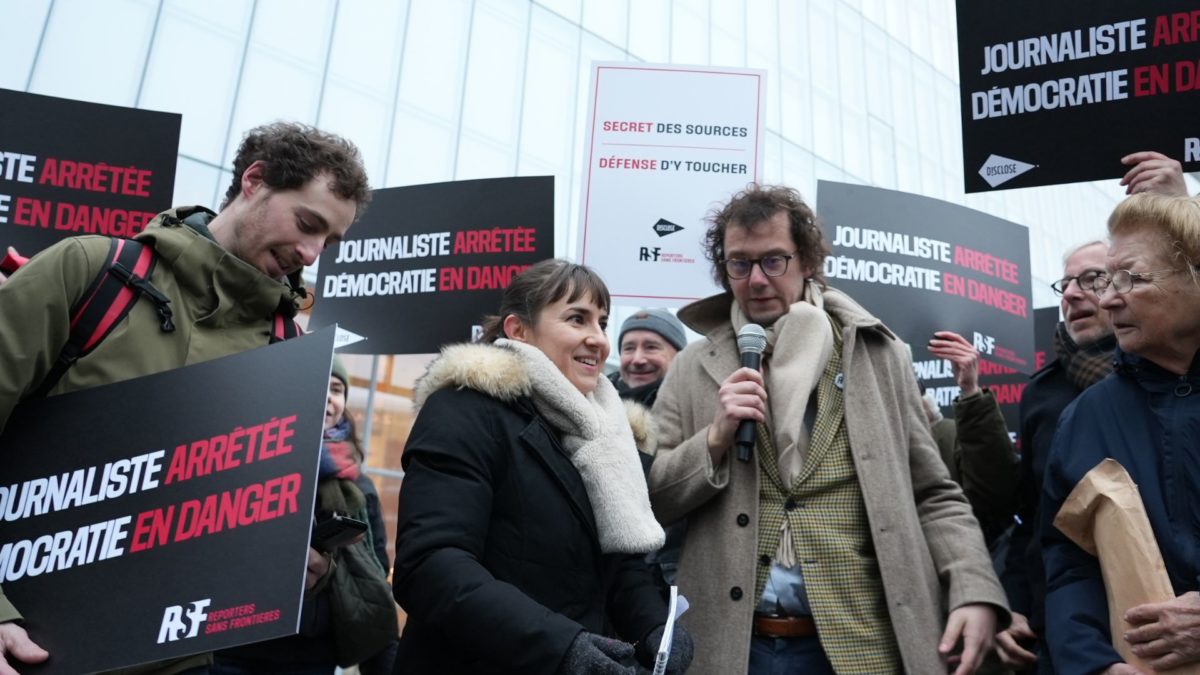
Charges against Disclose journalist Ariane Lavrilleux for violations of national defence secrets have been withdrawn. The Egypt Papers investigation she contributed to is “in the public interest,” the judiciary ruled. Disclose and some 100 organisations are now calling for a reform of the 2010 law on protection of the confidentiality of sources.
Ariane Lavrilleux walked out a free woman at 1pm on 17 January 2025 after being interrogated by two investigating judges from the antiterrorism unit of the Paris tribunal. She was grilled for three hours about her background, her views on “responsible journalism,” Disclose’s ways of working as well as her contribution to our revelations on Operation Sirli and French arms sales.
She was granted the status of “assisted witness,” which means that at this stage, she has not been indicted for “appropriation and disclosure of national defence secrets”. If her status remains the same until court proceedings are over, she will avoid a trial and the threat of a five-year prison sentence as well as a €75,000 fine. The NGO Reporters Without Borders, through Secretary-general Thibaut Bruttin, called for “all proceedings to be dropped” – an ex-serviceman was indicted in September 2023 in connection with the case. The judges told Disclose that they hope to close the inquiry “by the end of the year”.
Disclose’s investigation “in the public interest”
Pending the potential dismissal of the case, the decision of the Paris tribunal’s antiterrorism unit is both a victory for the freedom to inform and a setback for the armed forces ministry, which triggered the proceedings by filing a complaint against unknown persons in 2021. “The judiciary demonstrated on 17 January that it is not the armed wing of the Armed Forces Ministry by reasserting its independence,” Disclose’s lawyer Christophe Bigot said.
The judiciary acknowledged for the first time that “Disclose’s revelations are in the public interest” regarding Operation Sirli and its deadly excesses. The judges said their decision was based on “the nature of the information that was revealed”. In other words, a democratic state’s military cooperation with a dictatorship such as Egypt should be addressed in a public debate. National defence secrets are not absolute. They are even limited by the 9 August 2021 ministerial order which urges the authorities “never to invoke national defence secrecy arbitrarily or illegitimately”.
The two-year inquiry involved several intelligence officers of the General Directorate for Internal Security (Direction générale de la sécurité intérieure, or DGSI) and unprecedented surveillance and cyber espionage methods against a journalist and a media outlet. “Intimidation of journalists jeopardises their safety and their right to work freely, as well as everyone’s right to information and truth,“ said the president of the European Federation of Journalists, Maja Sever, at the support rally outside the Paris tribunal on 17 January. “Press freedom is not a privilege; it is the foundation of democracy,” she added.
Our five proposals to guarantee the protection of the confidentiality of sources
Disclose is not the only media outlet targeted by the DGSI. Since 2010, 27 journalists have been summoned or taken into custody by the DGSI, says Olivier Tesquet, a journalist with Télérama who also contributed to Disclose’s investigation on French-made surveillance equipment in Egypt. The aim is always the same: to find out who are the people who take risks to pass on to journalists confidential information that is in the public interest. The latest example is journalist Philippe Miller, who was taken in for questioning from a cafe in Paris on 4 December 2024 as he met a person suspected of violating the confidentiality of professional secrets.
The increase in freedom-curbing measures against journalists and their sources can be explained by the enforcement of the so-called Dati Law passed in 2010. The law, which is supposed to protect the confidentiality of journalists’ sources, is now obsolete. Its vague framework and the absence of genuine safeguards threaten independent journalism and the anonymity of all those who take risks to inform us.
Together with a group of journalists and lawyers (from Reporters Without Borders, Sherpa, Fund for a Free Press (Fonds pour une presse libre) and France’s National Union of Journalists), Disclose has come up with proposals to strengthen the confidentiality of journalists’ sources. The proposals have received support from more than 100 journalist organisations, unions and rights defence associations. They were sent to the Prime minister on 13 January, as well as to the four ministries concerned (culture, interior, armed forces and justice). These are the main points which we believe need to be implemented to strengthen the confidentiality of sources under the law:
- Provide a better framework for the confidentiality of sources to be lifted, as this is currently possible in the ill-defined case of “overriding public interest”;
- Demand an authorisation from an independent judge before the confidentiality of sources can be lifted;
- Extend source confidentiality to media workers, authors and documentary makers;
- Allow all journalists to defend themselves when protection of the confidentiality of sources has been violated by enabling them to challenge the order;
- Create the crime of offence to the confidentiality of sources.
Read the open letter in full here (in french)
The Disclose’s team
This investigation is free of charge, thanks to you
Because information is a public good, Disclose offers you all its investigations free of charge, without subscription or advertising. This model is unique in France for an investigative news outlet.
But it’s only possible on one condition: that readers like you support our not-for-profit newsroom. Donations to Disclose are eligible for a 66% tax reduction in France. So a donation of €100 will only cost you €34. Thank you for your support!


Read also
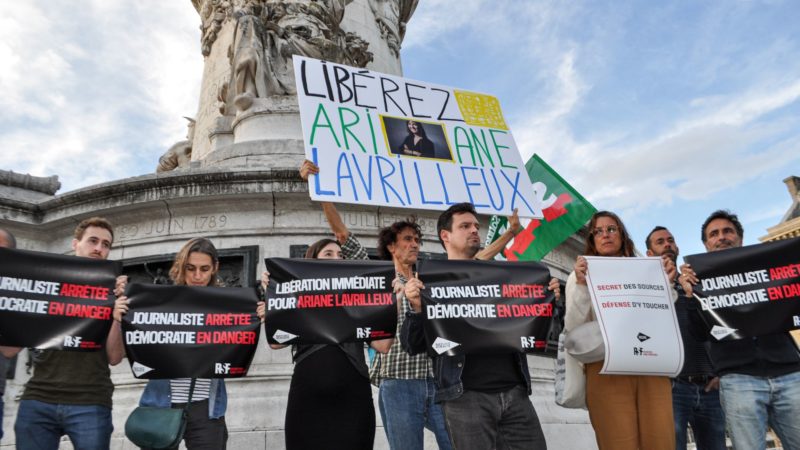
Attacks against journalists and their sources: Disclose journalist Ariane Lavrilleux summoned by French courts
Our journalist Ariane Lavrilleux is expected in the Paris court on January 17, 2025, which could lead to her indictment. The French state backlash against investigative media Disclose is reaching new heights.
State secrets: Disclose journalist taken into custody
On Tuesday 19 September, journalist Ariane Lavrilleux was taken into custody and her home searched by the DGSI. The aim of this unacceptable attack on freedom of the press was to identify Disclose’s sources, who helped to reveal the military operation “Sirli”, carried out by France in Egypt on behalf of the dictatorship.