French insurer AXA supports the main importer of Russian gas into Europe
French insurer AXA supports the main importer of Russian gas into Europe
Despite the war in Ukraine, French giant AXA is still providing insurance cover to Belgium’s Fluxys, which imports into France and Belgium gas held by oligarchs accused of funding Russia’s war effort, according to documents obtained by Disclose and NGO Reclaim Finance.
War has burst unexpectedly into Sabine’s living room*. The chemical engineer lives a two-minute walk from the North Sea and its stark light on the outskirts of Belgium’s most exclusive spa town, Knokke-Heist. Two years ago, the number of refrigerated lorries driving down her street skyrocketed, night and day. “I can no longer enjoy my garden. It is as noisy out there as an industrial estate,” she laments. The town is traditionally known for being attractive to pensioners looking for peace and quiet as well as open views onto the sea.
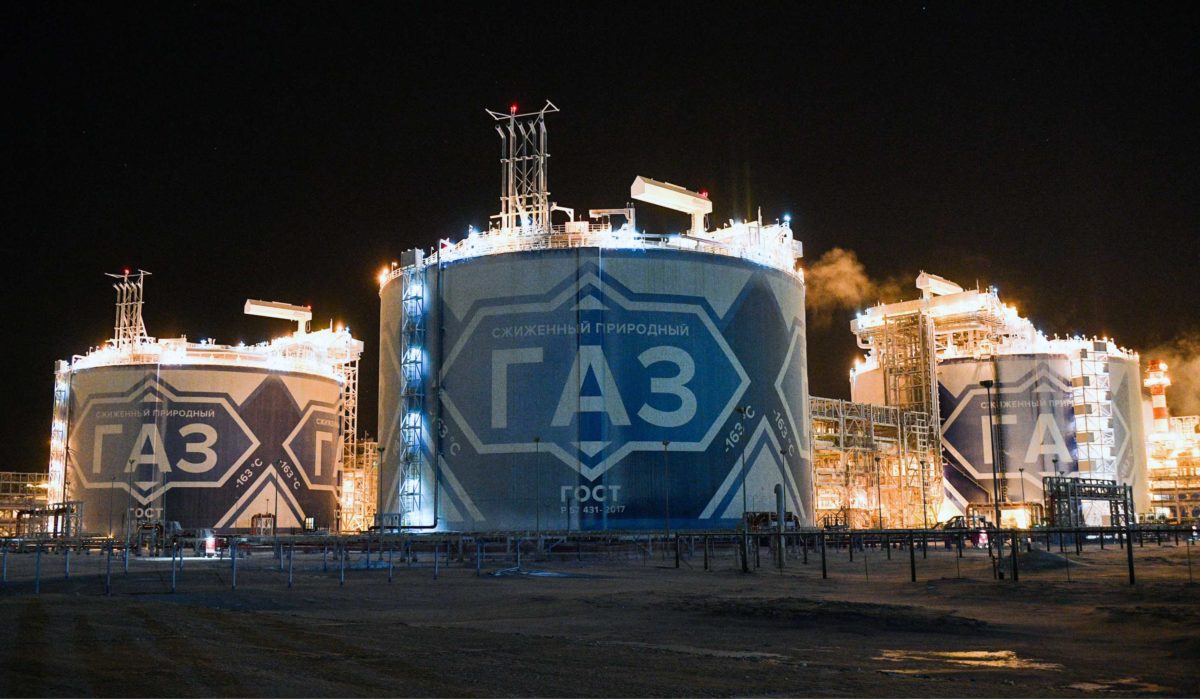
The vehicles that have gradually pervaded Sabine’s life carry liquefied natural gas (LNG), a raw material that they load at the Zeebrugge methane terminal, a 15-minute drive from where she lives. They then take the precious cargo across Europe. The methane terminal is owned by Belgium’s main gas sector player, a company called Fluxys that is known to buy massive quantities of gas from Russia. It is still the main purveyor of Russian LNG on the European continent, although there is a risk that the proceeds of its imports may be used to fund the war in Ukraine.
AXA and Fluxys: an enduring relationship despite the war in Ukraine
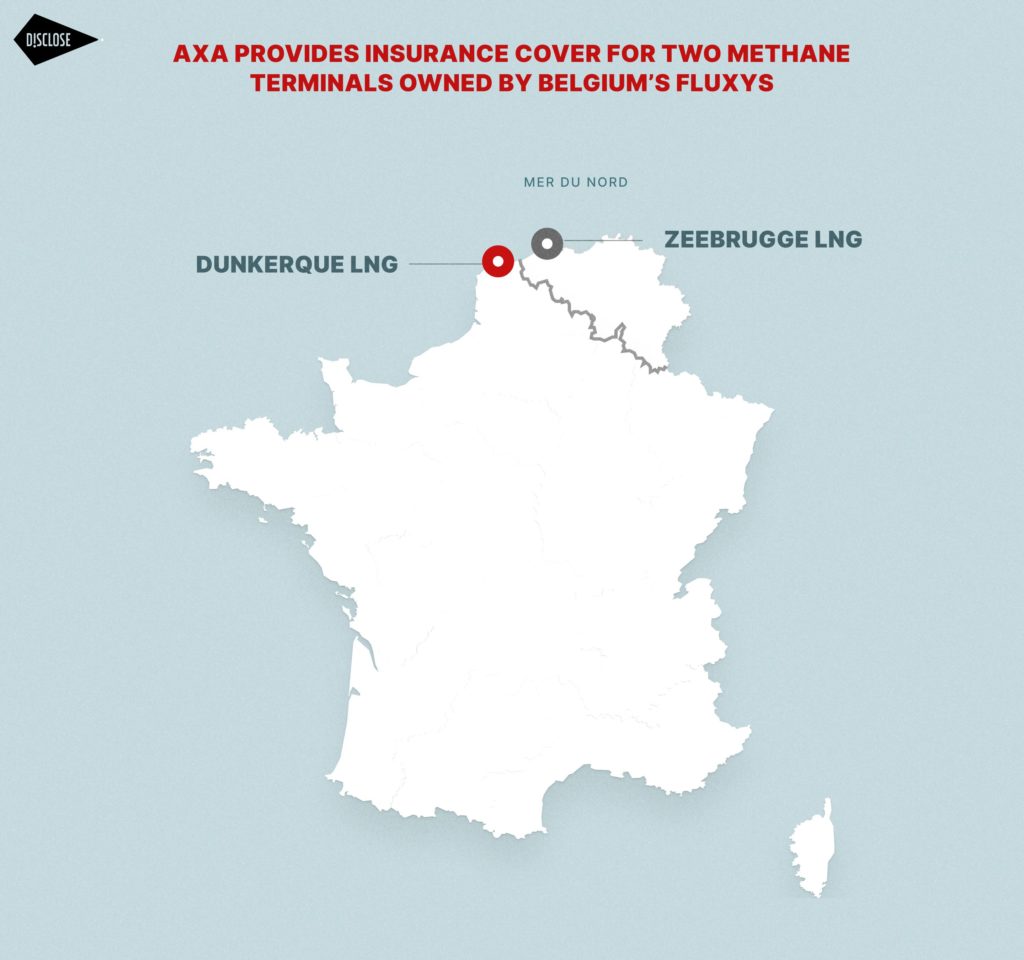
To carry out its activities, Fluxys, which made a net profit of €77m in 2023, enjoys discreet but significant support from insurance firm AXA. For more than seven years, the French company has been one of the main insurers of the Fluxys group. According to unpublished documents obtained by Disclose and Reclaim Finance, AXA provided comprehensive risk cover worth €60m to the gas company’s entire “network” for three years from 2016, including its “domestic transport pipelines” and “border to border transport”. In 2019, AXA signed another contract, this time to prevent “damage to property” at facilities in the Zeebrugge LNG terminal on the Belgian coast. We do not know how long the contract runs.
The contract also covers a French site, the Dunkirk LNG terminal, which has been in operation since 2017. It is separated from Zeebrugge LNG by a 100-km long beach. The terminal, with its three distinctive large reservoirs that are used to store LNG, is Europe’s second largest regaseification methane terminal. It can meet 20% of gas demand in France and Belgium. AXA, in addition to insuring Dunkirk LNG, is also one of the main shareholders of the company through its subsidiary called AXA Investment Managers.
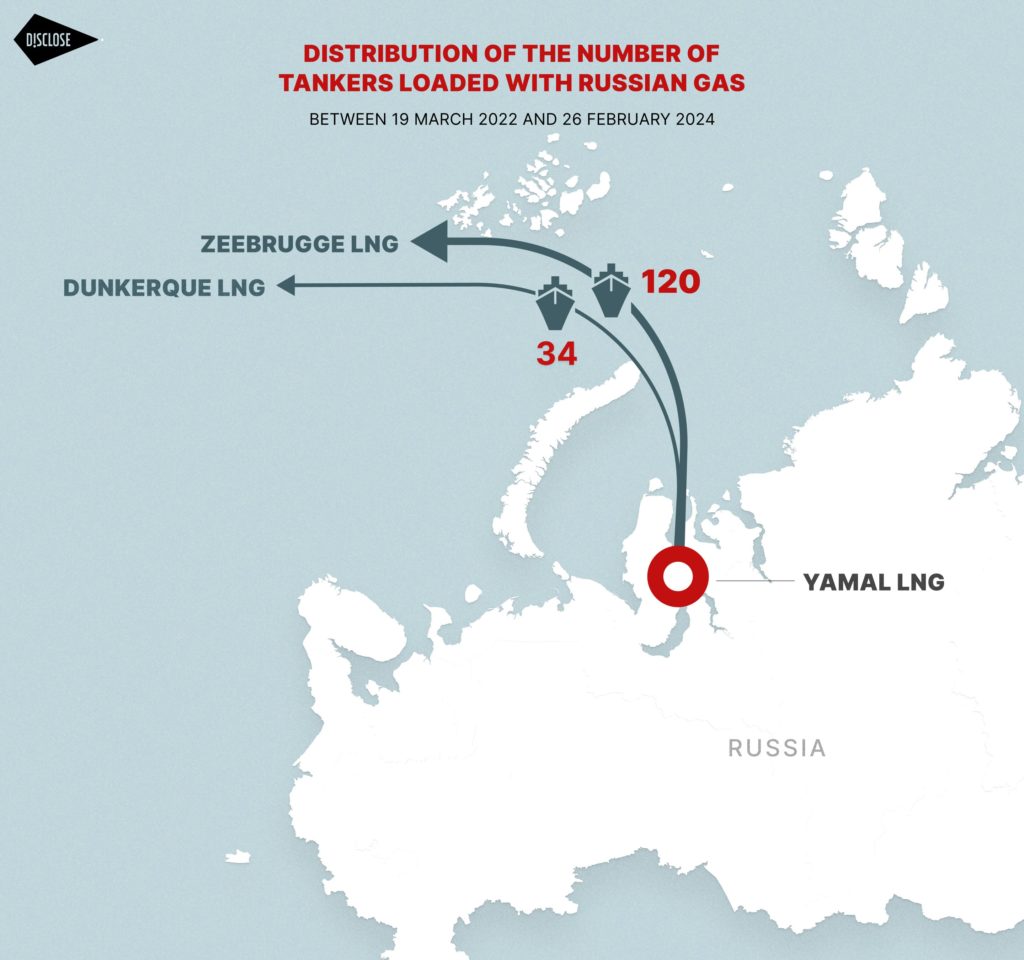
Some of the gas unloaded by tankers in Zeebrugge and Dunkirk comes from a terminal called Yamal LNG in the Arctic Circle, some 2,500 km from Moscow. In 2023, as much as 38% of the gas exported to Europe from Yamal landed in Fluxys’ tanks in France and Belgium, according to data from the Institute for Energy Economics and Financial Analysis (IEEFA). Yet the gas that is extracted in Yamal is produced and sold by Novatek, a gas group held in part by a Russian oligarch. Gennady Timchenko, who is close to Vladimir Putin, has been under sanctions imposed by the European Union since 2022 for supporting “actions undermining or threatening the territorial integrity, sovereignty, and independence of Ukraine,” according to the EU.
Novatek seems to be a key link in the war waged by Russia’s president against Ukraine. As early as the end of 2022, in order to fund the war effort and mitigate the economic losses caused by international sanctions, the State Duma, Russia’s lower house, announced a rise in taxes on the country’s main energy companies including Novatek. The tax raised €3.74bn on the Yamal LNG terminal alone in 2023, according to Belgian NGO Bond Beter Leefmilieu. Gas exports to Fluxys terminals are reported to have yielded more than a billion euros last year.
Terror risks and political violence
According to another document that Disclose and Reclaim Finance have had access to, AXA and Fluxys also entered into an insurance contract in 2023 – more than a year after Russia invaded Ukraine – covering “terror risks and political violence”. The policy, which runs for 24 months, includes clauses for disturbance, coups and sabotage against facilities in Dunkirk and Zeebrugge. The trouble is that when the contract was signed, AXA could not have been unaware that its Belgian client buys gas from a company that is strategically important for the Kremlin. This is all the more embarrassing that the new contract was signed only four months after the insurance company announced pulicly that it would no longer “clinch new deals concerning assets in Russia owned by Russian nationals”. When asked about this point, the French group dodged the question, explaining that it has “fully applied all international sanctions”. It was just as vague regarding other contracts with Fluxys: AXA “neither confirms nor denies the identity of its customers”.
On 1st August 2023, only 20 days after AXA and Fluxys signed the contract, a new piece of information confirmed the involvement of the Russian gas supplier in the war. According to Russian investigative site iStories, Gennady Timchenko, the owner of Yamal LNG, and his partner, Leonid Mikhelson, have been funding Russian paramilitary groups in Ukraine. A few months after these revelations, in late 2023, the Ukrainian authorities added Fluxys to the list of “international war sponsors” because Fluxys “contributes to the budget of the aggressor state, which allows it to finance war crimes against the people of Ukraine”.
Despite the intensity of conflict, it seems that Fluxys never considered switching to alternative gas suppliers. Between February 2022 and March 2024, 154 tankers travelled to and fro between Yamal and the company’s methane terminals in Dunkirk and Zeebrugge, according to an assessment carried out by German NGO Urgewald for Disclose. The journeys were made by, among other tankers, the Christophe de Margerie, named by TotalEnergies after its late CEO who died in a plane accident in Russia in 2014. The French oil and gas multinational holds 20% of Yamal LNG shares.
“Liquefied natural gas has nothing to do at all with transition to other sources of energy, whether the gas comes from the Gulf of Mexico in the United States or from the Arctic. The development of new LNG infrastructure contributes directly to climage change and to the increase in natural disasters,” says Ariel Le Bourdonnec, in charge of insurance at Reclaim Finance.
A few weeks ago, Fluxys put out a tender in a bid to renew its insurance contracts for 2024-2026. The CEO of AXA, Thomas Buberl, said at the end of February in an internal video obtained by Disclose that it would be necessary “at some point to switch from LNG to a more sustainable source of energy”. The tender is a perfect opportunity for him to prove that the group’s transition to other sources of energy does not include cover for extremely polluting LNG terminals stained with Ukrainian blood.
*The name has been changed
Investigation: Alexander Abdelilah
Editing: Mathias Destal
Translation: Béatrice Murail
Photo: Maksim Blinov/Sputnik/Sipa
This investigation is free of charge, thanks to you
Because information is a public good, Disclose offers you all its investigations free of charge, without subscription or advertising. This model is unique in France for an investigative news outlet.
But it’s only possible on one condition: that readers like you support our not-for-profit newsroom. Donations to Disclose are eligible for a 66% tax reduction in France. So a donation of €100 will only cost you €34. Thank you for your support!