Poisoned legacy of nuclear testing in French Polynesia

Disclose and its partners have spent two years investigating the health consequences of nuclear tests in French Polynesia.
Leukemia, lymphoma, cancer of the thyroid, lung, breast, stomach … In Polynesia, the experience of French nuclear tests is written in the flesh and blood of the inhabitants. Strontium has eaten into bones, cesium has eaten away at muscles and genitals, iodine has seeped into the thyroid.
The story of this largely unknown health disaster began on July 2, 1966. On that day, the army carried out the Aldebaran fire, the first of the 193 tests fired from the nuclear atolls of Moruroa and Fangataufa until 1996. The first , also, of a series of tests among the most contaminating in the history of the French nuclear program: the tests in the open air. Between 1966 and 1974, the military carried out 46 such explosions.
Disclose and Interprt, in collaboration with the Science & Global Security program at Princeton University (USA), investigated the consequences of atmospheric testing in French Polynesia for two years. With the help of thousands of declassified military documents, hundreds of hours of calculations and dozens of unpublished testimonies, this investigation demonstrates for the first time the extent of the radioactive fallout that struck the inhabitants of this vast territory as the ‘Europe.
According to our calculations, based on a scientific reassessment of the doses received, approximately 110,000 people were infected, almost the entire Polynesian population at the time. Modelling toxic clouds to support, we also unveil how the French authorities have concealed the true impact of nuclear testing on the health of Polynesians for more than fifty years.
On February 18, 2020, the National Institute for Health and Medical Research (Inserm) published, at the request of the Ministry of Defense, a report on “the health consequences of nuclear tests” in French Polynesia. According to this expertise, its authors felt that they could not “make a solid conclusion” to the existence of “links between the fallout from atmospheric nuclear tests and the occurrence of radiation-induced pathologies”. And the college of experts stressed the need to “refine the estimates of doses received by the local population and by civilian and military personnel”.
This request, made by victims’ associations for nearly ten years, is precisely the subject of this independent reconstruction. A far cry from the opacity and lies that the state has been trying to maintain for half a century.
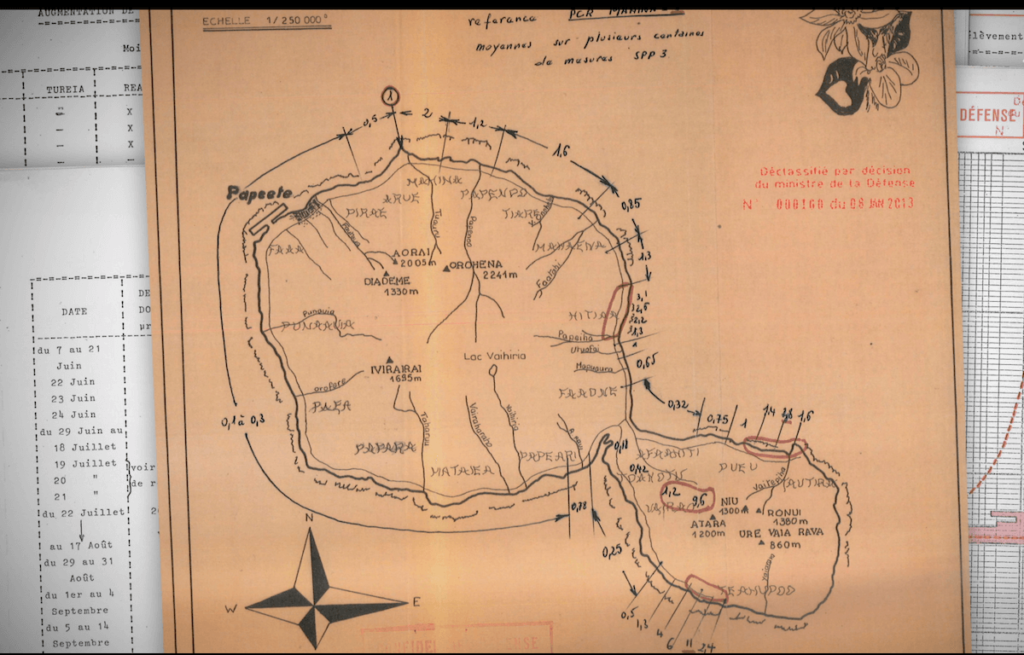
2 000 declassified documents
The key source material of our investigation is a set of declassified documents from the French Ministry of Defence that broadly covers a period between 1966 and 1974 when it conducted 41 atmospheric tests in French Polynesia. The documents were made public in 2013 after a long legal battle between French and Polynesian victims rights organizations and the government but have not been scrutinized in detail until our investigation. The archive consists of 233 documents that come to over two thousand pages. We have organized the documents in chronological order following each nuclear test campaign for use by victims, researchers and the general public.
Along with the study of the documents, we carried out interviews with more than 50 people, including 18 inhabitants of Polynesian atolls, 16 former military personnel, as well as with magistrates, scientists and organisations from civil society in both French Polynesia and mainland France.
A special website
This interactive platform exposes, for the first time ever, the information that has been hidden from public debate by the French authorities for five decades. Using 3D modelling tools and the visualisation of data, we have reproduced, for the first time ever, the events that followed the most contaminating of France’s atmospheric nuclear explosions carried out between 1966 and 1974. We also re-evaluated the extent of the radioactive contaminations these caused, and in which the civilian populations were the principal victims.
Disclose
On the same topic
Moruroa files
Read the collectionRead also

Toxic: members of parliament condemn silence on nuclear testing in Pacific
“A denial of reality”, “a stubborn silence”… Four years after Disclose’s revelations, the parliamentary commission of inquiry on nuclear testing in French Polynesia has confirmed the extent of the state’s cover-up since the 1960s. The members of parliament are calling for the compensation scheme for civilian and military victims to be overhauled.

Moruroa Files: investigation into French nuclear tests in the Pacific
France has consistently underestimated the devastating impact of its nuclear tests in French Polynesia in the 1960s and 70s, according to groundbreaking new research that could allow more than 100,000 people to claim compensation.