Shale gas imported into Europe: TotalEnergies’ health and environmental scandal in the United States
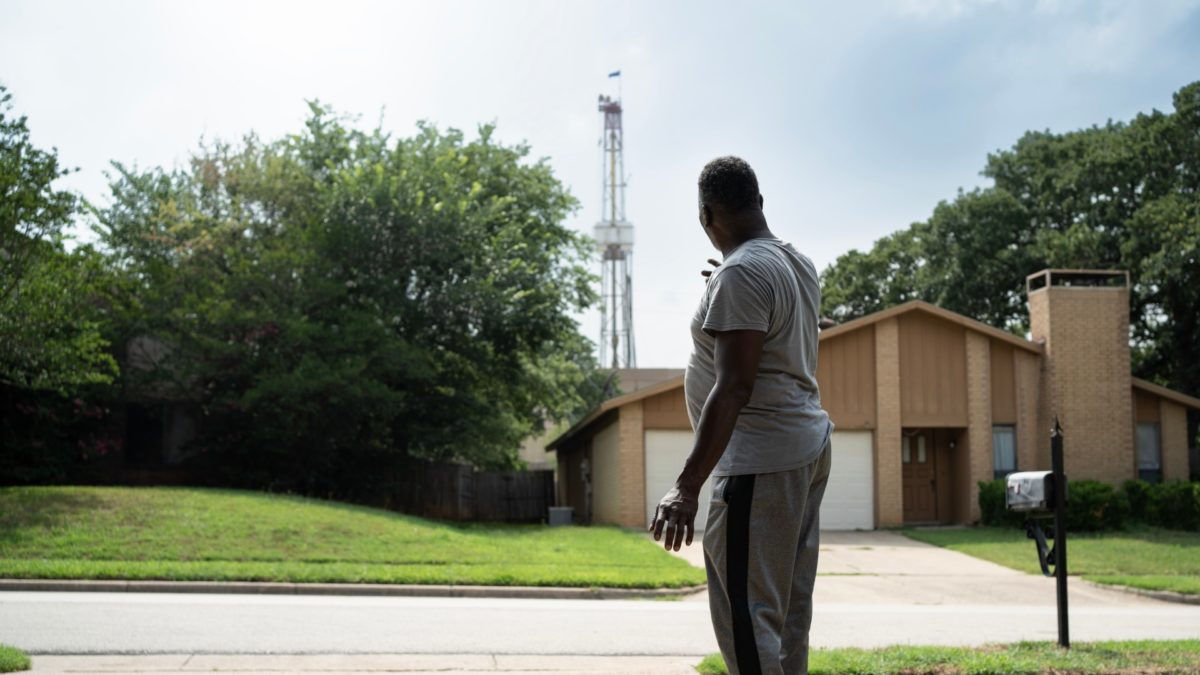
TotalEnergies is flooding France with liquefied natural gas (LNG) from the United States. But in Texas and Louisiana, producing this fossil fuel causes environmental damage and is a health hazard for 420,000 Texans. Alexander Abdelilah’s investigation took him to the heart of the French multinational’s American dream as its LNG floating terminal arrived in Le Havre.
It is stifling hot, so damp you can hardly breathe and hurricane warnings are issued on an almost daily basis. Welcome to Arlington, Texas: population 400,000 and no public transport. Less well-off locals walk along six-lane roads, through tall grass burned by the Texas sun. Shiny pick-up trucks from wealthier areas whiz by. In sharp contrast, in Black working-class neighbourhoods, countless billboards advertise payment facilities for second-hand cars. The distinctive feature of the city, 35 km from Dallas, and of the region, lies in its subsoil: it contains significant quantities of valuable fossil fuel, shale gas. Extracting it through hydraulic fracturing, or fracking, is a water pollution hazard. Air pollution is also a threat because of emissions of methane, a gas that causes 80 times more pollution than CO2. Fracking, the only shale gas extraction method, has been banned in France since 2011, but shale gas imports are not prohibited in the country.
When I visited on 14 June 2023, a strange smell irritated my throat as I turned a street corner. Only a few minutes later, I had a headache and felt dizzy. My attention turned to a high wooden enclosure with a “No Smoking, No Lighter” sign. The ordinary-looking hoarding in the midst of an urban area, around which dozens of laborers were busy working, concealed a gas field owned by TotalEnergies. The French fossil fuel giant is the top gas well owner in Arlington, ahead of Sage and BKV. The multinational owns 181 shale gas wells there through its subsidiary TEP Barnett, and it is awaiting the go-ahead to own an additional four. Some of these wells are located just a few dozen metres from schools and kindergartens.
TotalEnergies also operates some 1,700 gas fields in other areas of Texas, with potentially tragic health consequences for locals. According to exclusive data collected by Disclose through NGOs Earthworks and FracTracker Alliance, 420,000 people are believed to be directly exposed to toxic emissions from TotalEnergies’ gas drilling activities in the region. All live less than 800 metres from a well owned by the energy company, and scientific studies — such as a meta-analysis produced by Environmental Health Perspective in 2017 — have shown that emissions at this distance impact people’s health.
LNG: The Big Con
Since 2016 France has imported vast quantities of shale gas in the form of what it describes wrongly as “a transitional source of energy” or even as “clean fuel”: liquefied natural gas (LNG). Billions of cubic metres of LNG have been shipped aboard huge tankers from the United States to terminals in Dunkirk (on the north coast), Fos-sur-Mer (south coast) and Montoir-de-Bretagne (west coast). The war in Ukraine, which put an end to pipeline gas imports from Russia, has only reinforced the trend: the quantities of LNG imported into France was 3.5 times higher in 2022 than in 2021, to the benefit of TotalEnergies and Chairman Patrick Pouyanné, now the top exporter of US LNG to Europe whilst continuing to operate in the Russian LNG supply chain. According to a survey conducted by Paris-based independent consultants Carbone 4, GNL shipped from the United States across the Atlantic is the type of imported gas with the highest carbon footprint: 2.5 higher than gas transported via pipelines.
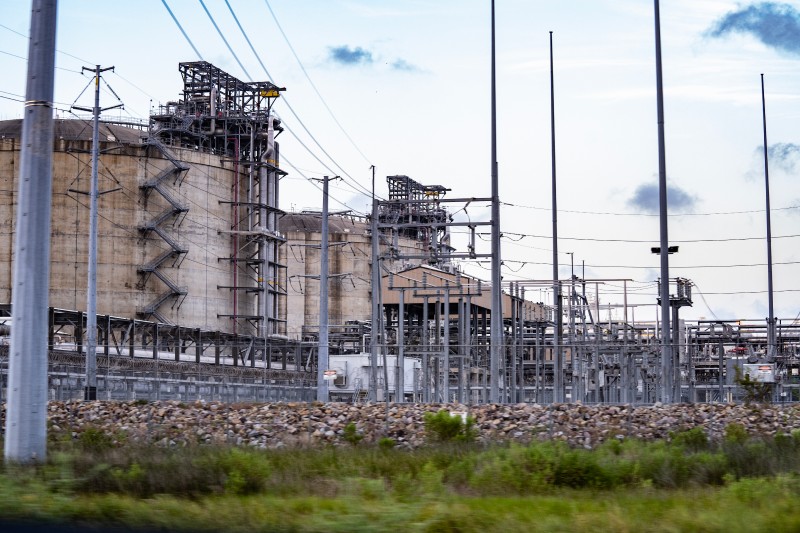
This momentum is evidenced by the fact that TotalEnergies, after intense lobbying, managed to impose the emergency installation of a new LNG terminal in France in contempt of environmental regulation. The FSRU Cape Ann has just started operating in Le Havre harbour with the purpose of increasing US LNG import capabilities. The operation is extremely cost effective for the oil and gas industry giant: in addition to operating the terminal in Le Havre and being its main customer, TotalEnergies holds stakes (16.6%) in export terminal Cameron LNG across the Atlantic. It is also involved at various levels in other US export terminals such as the controversial Rio Grande LNG project. Finally, a part of the LNG that reaches French coasts is reported to have come from its own shale gas wells in Texas.
In Total City Hell
Back in Arlington, the French energy company’s gas wells are located in the heart of residential areas despite obvious health hazards. Texas has the fourth largest environmental agency in the United States, the Texas Commission on Environmental Quality (TCEQ), which is supposed to be relatively independent from the fossil fuel industry. Disclose asked the regulatory authority if residents had lodged complaints against TotalEnergies’ drilling activities. The environmental agency told us about 27 complaints of dizziness, nosebleeds and headaches, i.e. all the symptoms that scientific studies associate with exposure to toxic substances released by shale gas drilling. For instance, in March 2020, a resident complained about smells that had started several months earlier, causing nausea and headaches. In February 2022, another stated that black smoke was rising from a drilling site, causing him and his family sudden hair loss. Two months later, a third person described the presence in the air of unidentified matter killing vegetation and causing breathing problems.
In April 2022, Anne Mattern had first-hand experience of one of the incidents involving TotalEnergies. We visited the lively Texan, a former nurse training for a new occupation, in her bungalow in Fort Worth, a city near Arlington. She dived into her computer’s archive for a timeline of events. She said that she had once heard a huge blast in the dead of night, “almost earthquake like”. In the small hours, she had found the area cordoned off by police and fire fighters. “There was a strong smell in the air,” she said. A police officer explained to her that “salt water” had reportedly escaped from a well owned by TotalEnergies – a possible reference to the mix of water and chemicals injected into rock to extract gas. His answer was so vague that she did not find it convincing. In the chatroom set up by neighbours for the area, people were panicking. Some described strange greasy rain smelling of petroleum while others said the vegetation had been totally burned in places. A neighbour shared a video where the gaseous substance can be seen rising from the drilling site.

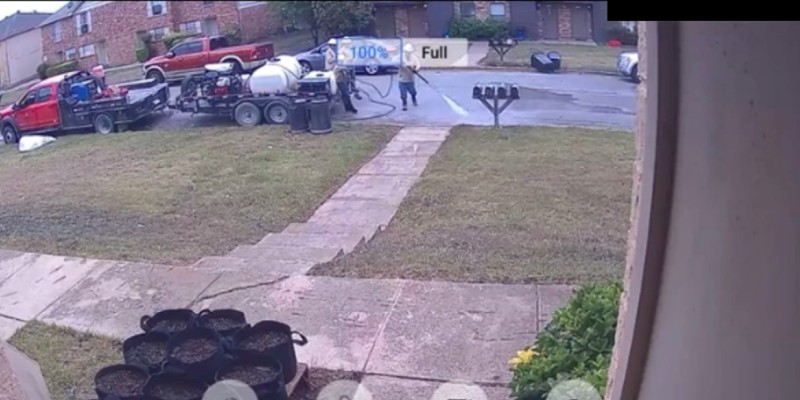
In footage obtained by Disclose and filmed by CCTV at a house two days after the incident, a team of four men wearing hard hats and waterproof clothing can be seen cleaning the road with a Karcher. They were hired by TotalEnergies “to clean up the liquid that escaped from the drilling site at the affected properties,” said the TCEQ, contacted by Disclose. This was confirmed by the management of the oil and gas company, who said they have taken “the necessary steps to rehabilitate the premises”.
After the incident, the company handed out car wash vouchers to several residents as compensation. But Anne Mattern raised the issue with the French multinational and the TCEQ. Both pledged to conduct soil tests, in vain. When approached for comment, TotalEnergies argued that “the results of samples collected at the property were examined and explained to residents”. Disclose requested a copy but the company failed to provide one.
Children suffer as a result of drilling activities
Southeast of Arlington, in a residential area where TotalEnergies is drilling new wells, Edgar is busy outside his house. The former truck driver is doing up an old red and white Ford Mustang. He and his family have lived in the area for some 30 years but his wife and daughter have recently had recurring nosebleeds and severe headaches. The symptoms appeared when the drilling started. His two grandchildren, who live with them, also fell ill quite suddenly. “Doctors diagnosed an allergy, but things are getting worse,” he says. “The little girl, who is a year old, almost chokes from coughing so much, which we find very scary.” This could be a case of flowback, when chemicals injected at high pressure into rock rise back to the surface.

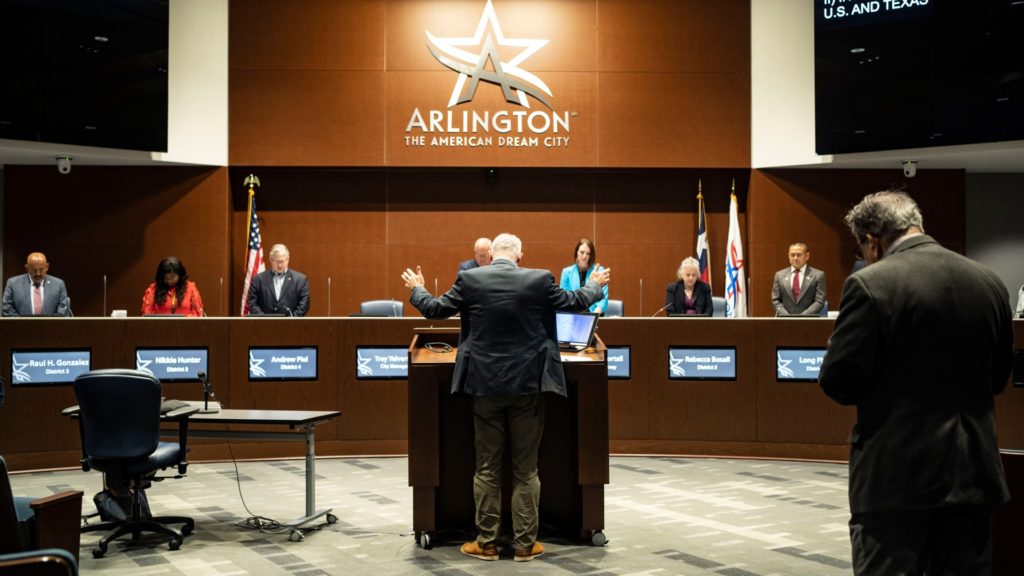
“I’m alarmed by the amount of asthma in Tarrant Country among children,” warns Russ Gamber, a retired general practitioner who lives in Arlington. His fears seem to be confirmed by several scientific studies published over the past few years. They establish a link between shale gas drilling and the rise in breathing problems among children. “I see no concern on state level, little to no concern on city level,” Gamber says, but he urges the Arlington city council to stop approving additional drilling, as it did in early 2022 on a one-off basis: Texas law makes it harder for municipalities from turning down drilling unless it is motivated by “commercially reasonable” arguments. At the time, TotalEnergies was applying for an extra licence to operate one of its fields some 100 metres from a childcare facility, the Mother’s Heart Learning Center, with about 100 children. The city council rejected the application in a resounding vote following a protracted campaign by neighbours and Liveable Arlington, a residents’ association set up by Ranjana Bhandari in 2015. At the end of 2021, the director of Mother’s Heart filed a complaint with the Texas Commission on Environmental Quality after some of her staff started feeling unwell.

Because of the lack of transparency of the US gas network, we cannot be 100% certain that shale gas produced in Texas by TotalEnergies is shipped to France directly but there are definitely some connections. First clue: a TotalEnergies graph lists gas from the Arlington area as one of upstream gas assets. Second clue: a contract stating that gas produced in the region by the multinational is turned over to freight company The Williams Companies, which supplies power plants in Texas as well as LNG export terminals in the Gulf of Mexico. Before US gas reaches Europe, it transits through Louisiana, among other places, including through one of its main methane terminals, Cameron LNG, in which TotalEnergies holds shares. When questioned on this point, the company said that their shale gas “is not exported but sold locally” by business customers. A shrewd answer that does of course steer clear of revealing how their shale gas is used, by whom and where.
“We used to be able to hear the waves but now we can only hear the flaring”
Nicole Dardar, fisher in Louisianna
The drive from Arlington, Texas, to the Cameron LNG site in the Gulf of Mexico, Louisiana, takes more than five hours. Here, there is water everywhere. Stretches of land are framed by lakes, the landscape is criss-crossed by hundreds of canals. Everyone is involved in the gas industry, one way or another. Nicole Dardar runs a prawn-fishing business with her husband. The Dardars, whose ancestors settled in the area several generations ago, have just sold their land to Venture Global, who is planning to expand its terminal, Calcasieu Pass, located not far from their home. Dardar’s relief is bittersweet: “We used to be able to hear the waves from our place but now we can only hear the flaring,” (Editor’s note: intermittent burning in the open air of superfluous gas) she says. “At night, it floods our garden with light.” Flaring accounts for up to 10% of methane emissions from the US oil and gas industry.
In addition to health hazards, the dramatic increase in the demand for US gas is causing serious environmental damage. By 2026, according to the University of Louisiana, the LNG industry in the state will release close to 55 million tonnes of greenhouse gases. And problems are already palpable, starting with coastal erosion caused by the widening of canals and the constant movements of ever larger tankers. “They have broken the water’s natural cycle,” says another fisher, Eddie Lejeune, who has worked in the vicinity of the Cameron LNG terminal for 40 years. “With the arrival of super tankers generating waves more than two metres high, nothing can resist now, not even oysters.” Pointing to the canal that runs outside the house he shares with his wife and children, he adds: “Every time tankers go past, they stir toxic sediments rejected by the oil and gas industry which then come up to the surface. In winter, smoke can be seen rising from the canal water”. According to US government data, since the invasion of Ukraine in February 2022, 38 of these super tankers full of LNG left Cameron to supply one or more French ports. And the frenzy is not about to end: three new export terminals are currently being built in the region.
Reporter: Alexander Abdelilah
Header image: Nitashia Johnson
Editor-in-chief: Mathias Destal
Publisher: Pierre Leibovici
Translator: Béatrice Murail
This story was published in collaboration with Libération and received support from the Sunrise Project
Read also

Decathlon’s Quechua shoes manufactured by suppliers linked to deforestation in Brazil
Decathlon’s top two footwear manufacturers source leather that may have come from illegally deforested areas in Brazil. Disclose and Follow the Money have traced back the production chain of the famous Quechua hiking shoes after seeing confidential documents.
French banks make a profit from the polluting oil and gas industry in the Amazon basin
In disregard of their ecological commitment, banking groups Credit Agricole, BNP Paribas and BPCE have been investing very discreetly in fossil fuel multinationals accused of polluting the Amazon Basin, an investigation by Disclose, with France 24, RFI and the Pulitzer center can reveal. The French banks make more than €45 million from these investments each year.