ArcelorMittal: public money thrown at one of the worst polluters
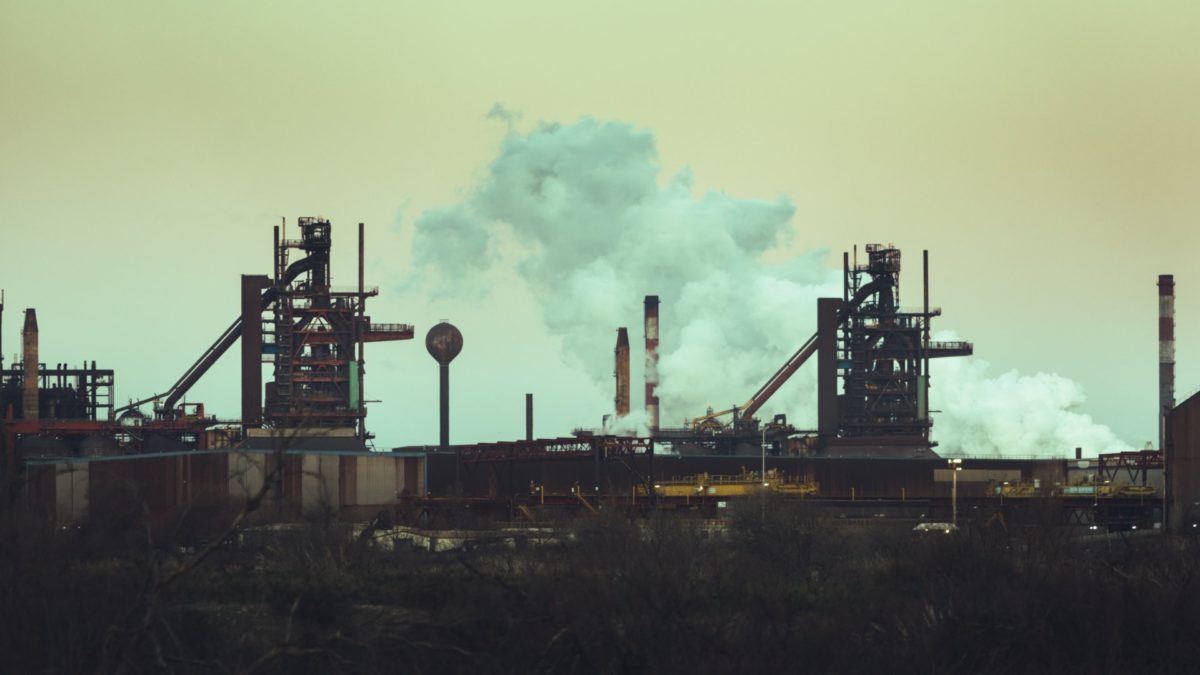
Steel giant ArcelorMittal is the company that is the worst polluter in France but also one of the most subsidised. Since 2013, it has received no less than €392m in public funding despite continued environmental regulation infringements and multiple convictions for polluting.
“As a company, you are responsible for 25% of [France’s] carbon dioxide emissions. Are you all right? Is it not too much to bear?” On 8 November 2022, as the leaders of the country’s 50 industrial sites that pollute the most met at the Elysée Palace, the event moderator challenged Eric Niedziela, ArcelorMittal’s climate action vice-chair. “No, we are all right, thank you. (…) ArcelorMittal, that’s also 15,000 jobs in France at 40 production sites,” Niedziela boasted. The sparring might have been surprising but it was only for show. In actual fact, the mining and blast furnace empire – the product of the merger, in 2006, between Arcelor and Mittal Steel Company – can rely on the unfailing generosity of the French government to remain the undisputed carbon emission leader in mainland France.
Disclose, in partnership with Marsactu and IrpiMedia, has worked out for the first time the amount of public funds ArcelorMittal has received over the past ten years, a corporation that emitted 14m tonnes of CO2 in 2021 from its two largest French plants in Dunkirk and Fos-sur-Mer. The result is enlightening, especially given that ArcelorMittal has benefitted from millions of euros in public funding despite continued environmental regulation offences and numerous convictions for polluting (read our investigation).
“digital transformation”
In addition to subsidies and tax credits, the French government has granted the corporation loans worth €2.5m at preferential interest rates. By having several legal entities, the steelmaker has also managed to rack up €192m worth of tax credits. Also, before prices soared in 2022, ArcelorMittal received at least €100m in public funding aimed at lowering energy-consuming industries’ electricity bills, Disclose’s estimates show. Finally, to help ArcelorMittal modernise its facilities, the government and local authorities have allocated €56m to the corporation.
ArcelorMittal’s imagination to get government funding is astonishing, to say the least. On 6 May 2020, at the height of the Covid-19 pandemic, Eric Niedziela, who was the director general of the Dunkirk site at the time, applied for subsidies worth €4.5m towards the plant’s “digital transformation”. The idea was to do away with the rounds conducted by maintenance staff and to replace them with meters requiring no human intervention. “The only problem is that these electronic tools do not work well because of the very high temperatures in the workshops and the huge amount of dust around,” says Philippe Reynald, the CGT trade union representative at the group’s central committee. Does this mean that the company has abandoned the project? Whatever the case may be, payments were approved in the autumn of 2020 by the Hauts-de-France regional authorities, led by former minister Xavier Bertrand of Les Républicains party. To date, ArcelorMittal says it has only received a transfer for €1.35m towards a project that was expected to be rolled out until 2023. The Hauts-de-France region’s communication service, which Disclose contacted for comment on several occasions, did not wish to answer our questions.
Two years earlier, in 2018, the environment agency (ADEME) had also granted funds worth €4.5m to ArcelorMittal Atlantique, which oversees the Dunkirk site. Disclose approached the agency and the environment ministry it is attached to but they did not get back to us.
“Licences to pollute” farce
The list of subsidies ArcelorMittal has received seems endless. Since 2006, the European Union has granted industrialists “carbon credits” also known as “licences to pollute”. The goal is to encourage them to reduce their CO2 emissions by attributing an annual emission allowance to each company. If the company exceeds the emission limits it has been set, it must pay a high levy by way of a deterrent or buy carbon credits from other companies that have not exhausted their allowance. But in practice the European Union has been so generous with cement and steel makers that ArcelorMittal never exhausts its allowance. The corporation is thus able to sell tonnes of CO2 to companies with less funding, including banks such as Barclays, BNP Paribas and Fortis. This absurd but legal trade made it possible for ArcelorMittal to reap at least €3.2bn until 2021 according to our estimates based on the mean trading price of carbon credits. ArcelorMittal did all this without ever reducing its own carbon emissions. And its profits may be even higher. According to a survey conducted by NGO Carbon Market Watch and consultants CE Delft, its allowance is believed to have enabled it to rack up €5.2bn over a decade.
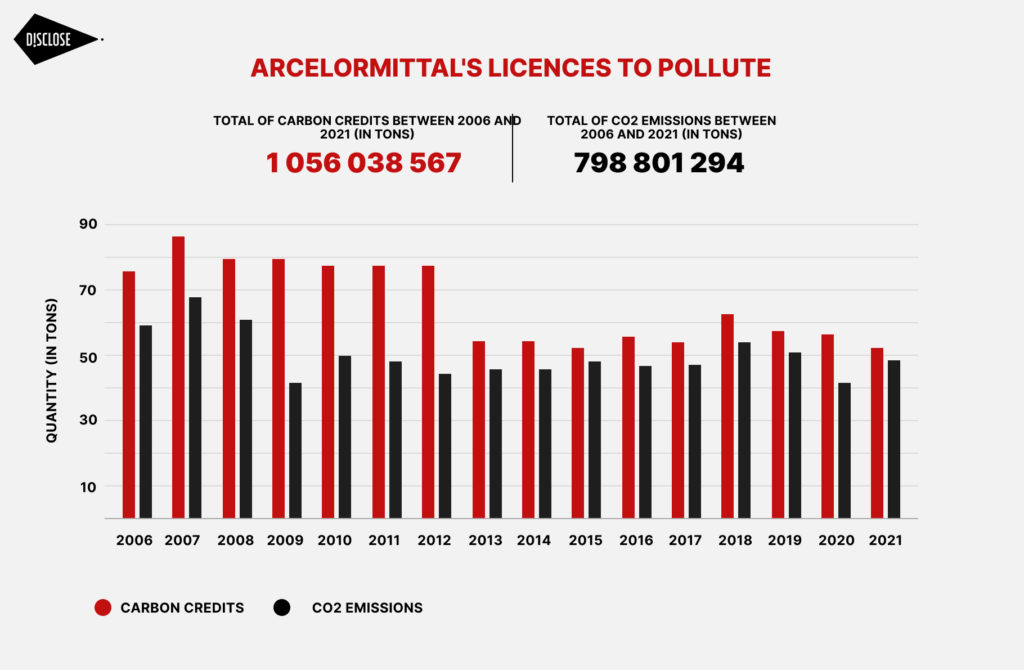
The European Union may have reviewed its carbon quotas at the end of 2022 but it made sure it did not antagonise the companies that pollute the most. Until 2030, the European Commission will keep offering licences to pollute to steel manufacturers without anything in return. Over the next five years, ArcelorMittal will get away with spewing the same quantity of CO2 it emitted in 2021 – 48.6m tonnes – without having to pay anything. The multinational may even have something to gain as the EU Commission has planned to grant it licences worth 56.7m tonnes of CO2 per year.
Funds lacking in transparency
That’s not all. Since 2008, according to public records compiled by Disclose, at least €1.5bn has been paid directly from EU coffers into ArcelorMittal’s accounts: half as subsidies (€635m) and half as loans (€705m). The money comes from the Horizon, Innovation and Cohesion funds for regional development and from the Life programme. The least transparent of these funds, which is called For Coal and Steel Research, has transfered no less than €77m to ArcelorMittal since 2008, according to data collected by NGO Lobbyfacts. Some of the research projects initiated by this fund have never come to fruition. The same applies to the carbon capture plant in Florange, eastern France, which was supposed to reduce CO2 emissions by 50%. The project was abandoned at the end of the 2000s because it was “technically and economically not sustainable at the time,” according to the company, quoted in a Senate report.
If we add up profits from carbon allowances, direct subsidies and loans, ArcelorMittal has accumulated at least €4.7bn of European public funding since 2008. When you know that lobbying European institutions has cost the company €14.5m over the past ten years, the return on investment is huge.
“Green revolution”?
So, what happened to European public funds? According to its works council, ArcelorMittal paid shareholders a total of €8.9bn between 2020 and 2022. But how European loans and profits from carbon allowances in particular have been used is still a well kept secret. There is no reference to them in the company’s business reviews.
One thing is for certain: the group’s efforts to protect the planet leave a lot to be desired. Over ten years, it has dedicated only 9% of its investments – that’s €3.6bn – to reducing its impact on the environment. As for decarbonation, i.e. investments to reduce its CO2 emissions, ArcelorMittal has only committed €1.8bn over 10 years, out of €57bn of investments around the world.
Although nothing and no one compels the steelmaker to make such a pledge, it has promised a “green revolution” for the current decade. By opting for a coal-free process, which has already been tried and test in the USA, it is aiming to reduce its CO2 emissions by 40% in France and by 35% in Europe by 2030. In Dunkirk, one of the three traditional blast furnaces will be replaced by an electric oven. There is one condition though: government authorities will have to contribute “40 to 50%” of the cost of the project estimated at €1.4bn, Thibaut Maugenest, in charge of ArcelorMittal’s decarbonation programme, announced publicly last November. That’s €600m-700m, which would add to the €15m pledged by Economy Minister Bruno Le Maire to the leaders of the Fos-sur-Mer site who are moving in the same direction. All this at the taxpayer’s expense.
Nina Hubinet and Ariane Lavrilleux
The investigation was conducted with support from the Journalismfund
Read also
ArcelorMittal: coal arriving in Dunkirk causes environmental and health disaster in Mozambique
The factory that produces the most pollution in France is using more coal than ever. In August 2025, ArcelorMittal Dunkirk took delivery of several thousand tonnes of coal from an extremely toxic mine in Mozambique. Some residents of the town of Moatize have been exposed to serious air pollution and seen their homes destroyed by blasts, an investigation by Disclose and Socialter can reveal.
PFAS in agriculture: the factories spreading their toxic waste in fields
A quarter of the 100 industrial sites discharging the largest quantities of forever chemicals in France have been supplying the agricultural sector with “sewage sludge” meant to fertilise fields. The toxic fertiliser has been spread over several thousand hectares, Disclose can reveal in partnership with France 3. The French authorities have struggled to take the measure of this health and environmental time bomb.