Shale gas: three French banks finance a gas project in Texas that harms the climate

Shale gas: three French banks finance a gas project in Texas that harms the climate
Despite their commitment to leave fossil fuels behind, Société Générale, Crédit Agricole and Groupe BPCE invested close to €574m in June 2022 in an expansion project at the Corpus Christi gas terminal in the United States. The expansion, driven by the Cheniere Energy group, is expected to enable the company to increase its shale gas exports, including to France.
Have French banks finally abandoned fossil fuels? You would have been forgiven for thinking so when Société Générale and Crédit Agricole announced in March that they were pulling out of a vast methane terminal project in Texas called Rio Grande LNG. Such an about-turn is so rare that it was praised by environmental NGOs, and for a good reason. The Rio Grande LNG project, driven by NextDecade, would make it possible to spur exports of shale gas, which is extracted from the US subsoil through hydraulic fracturing. Not only is the process disastrous for the climate, because of methane emissions, but it pollutes groundwater. The two French banks may indeed have dropped the mega project but they have far from put an end to their financial backing for the gas sector in the United States.
Our investigation, based on a financial analysis by Dutch research organisation Profundo, can reveal that Société Générale and Crédit Agricole invested nearly €365m in June 2022 towards the expansion of a neighbouring gas site in Texas, the Corpus Christi terminal, owned by US giant Cheniere Energy. The project is all the more controversial given that almost all the liquefied natural gas (LNG) at the site is derived from shale gas, as revealed by Disclose in an earlier investigation. A third leading French investor can be found alongside Société Générale and Crédit Agricole: the Natixis bank (Groupe BPCE), which brought some €209m to the table. The three banks contributed a total of €574m to the Corpus Christi expansion project.

While “the terminal expansion would emit an additional 51 million tonnes of carbon dioxide equivalent each year, equivalent to the annual emissions from nearly 14 coal plants or 11 million cars,” according to the Sierra Club, a group of US environmental organisations, how can French banks justify their support for such an environment and climate aberration ?
Société Générale invokes business secrecy
When Disclose approached Société Générale, a self-proclaimed champion of “responsible finance” which says publicly that it does not back “companies whose income is associated with non-conventional oil and gas exploration”, it invoked “business dealings” to avoid our questions. Yet in its oil and gas investment policy enacted in January 2022, six months before the loan agreement with Cheniere Energy, Société Générale was adamant that it would not “deliver transactions, products and financial services” for schemes such as the “significant expansion projects in connection with the production or export of liquefied natural gas (LNG) in North America”. Only a footnote explains that such schemes will only be excluded “after the completion of the projects for which the Group has been mandated”. A way of saving the deal with Cheniere Energy? When we put this to the bank, it failed to respond. “If this is not a violation of its policy, then it is a disingenuous policy which can only mislead the bank’s stakeholders,” says Lucie Pinson, the director of Reclaim Finance, an NGO promoting energy transition.
Crédit Agricole’s so-called “greened” record
Crédit Agricole, which we also approached about its support for Cheniere Energy, told Disclose that it complies scrupulously with the International Energy Agency’s net zero emissions scenario. The bank highlighted its “role as a committed player in great societal transitions” and its “greened record” in its late 2022 action plan “to become carbon neutral by 2050”. It said it would reduce by “30% in absolute terms [its] financed emissions” in the oil and gas sectors by 2030. It stressed, however, that “gas will always feature in the global energy mix in the medium term and that it will start to decrease from 2025 only”. We contacted Groupe BPCE several times but they did not answer our questions.
“French banks, quick to assert their commitments to fight against climate change, are much less willing to follow through on their words, and give up financing profitable projects and companies that are incompatible with the goal of limiting global warming to 1.5°C,” explains Lucie Pinson. Société Générale, Crédit Agricole and BPCE have supported Cheniere Energy since 2016 to the tune of €7.4bn alongside BNP Paribas and Crédit Mutuel.
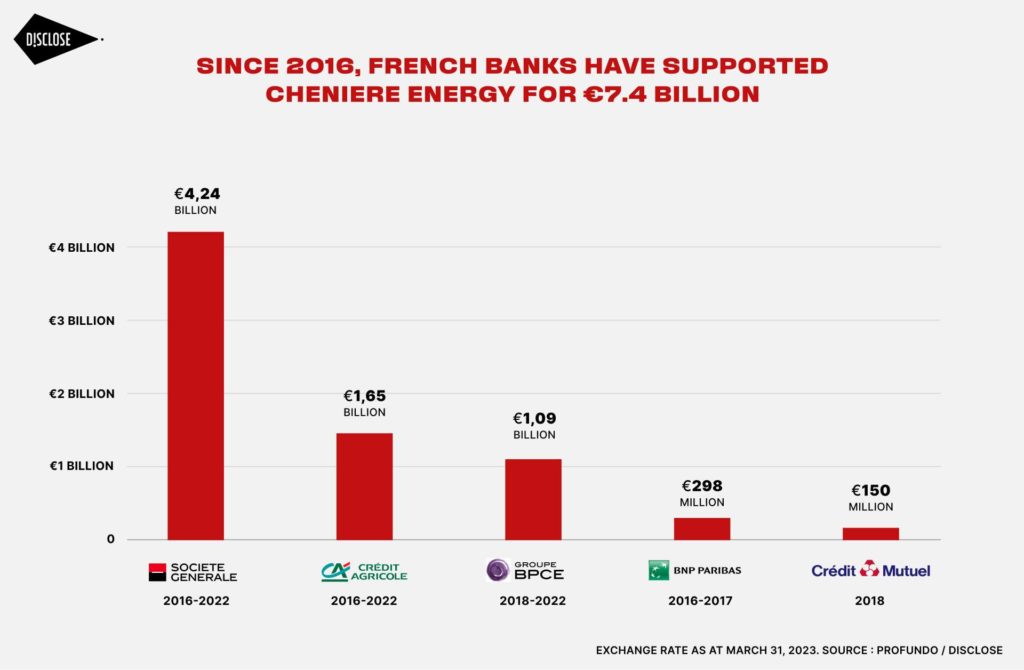
In the meantime, the US energy operator is thriving and is not planning to stop there. “Cheniere’s subsidiaries signed further long-term contracts in 2022 for a total of more than 180 million tonnes of LNG until 2050,” the company claims on its site. The fossil fuel giant announced in early 2023 that it aimed to expand its other terminal, Sabine Pass, in Louisiana. Despite Société Générale, Crédit Agricole and Groupe BPCE saying loud and clear that they were pulling out of fossil fuels, the Profundo data viewed by Disclose reveals that the three banks are once again prepared to give financial backing to Cheniere Energy. This time, they are supporting the issuance of bonds by the subsidiary managing Sabine Pass. Their final contribution to the US gas giant’s project harming the climate? €50m.