By purchasing Russian metals, Airbus and Safran indirectly contribute to the Kremlin’s war effort
Despite the invasion of Ukraine, European companies are allowed to purchase “critical” materials such as titanium, aluminum, or nickel from Russia. More than 13 billion euros worth of these metals have been imported into Europe since 2022. Aerospace giants like Airbus and Safran are benefiting from this, even at the risk of fueling the Kremlin’s war machine and enriching oligarchs who are already under financial sanctions.
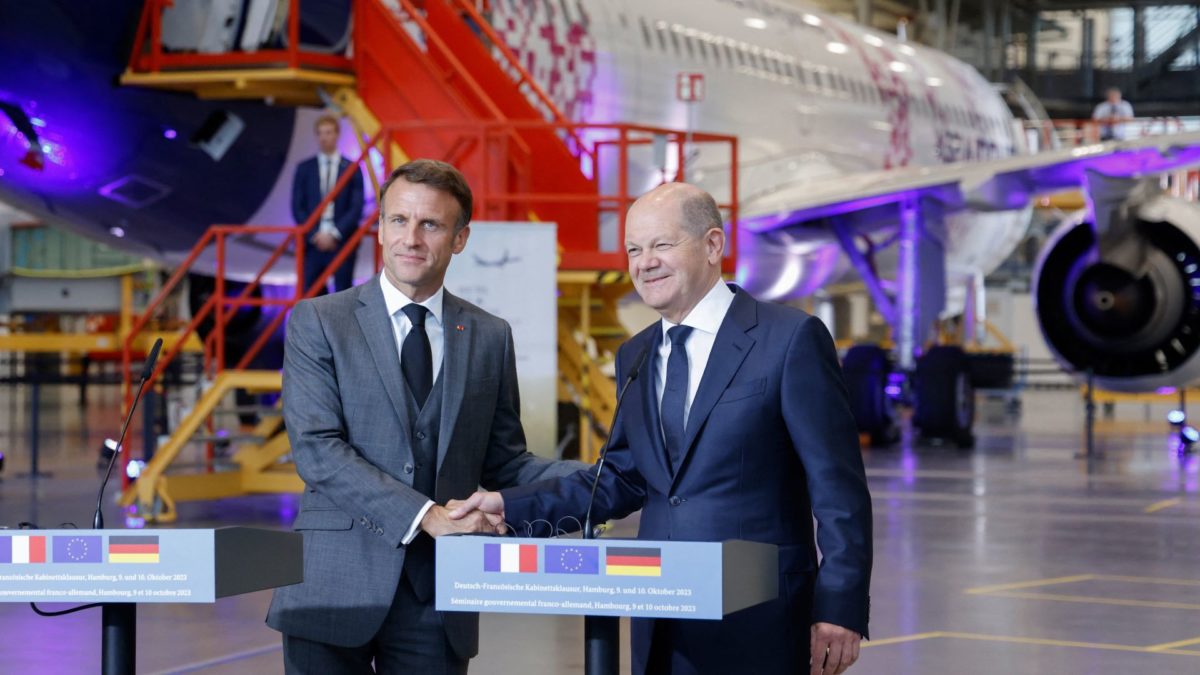
To shield themselves from the rain, they headed straight for the cockpit. Emmanuel Macron took the pilot’s seat, and Olaf Scholz, the German Chancellor, sat to his right. Each of them held the control stick of the Airbus A321, fresh off the production lines of the Hamburg factory. On this Monday, October 9, during an official visit by the two leaders to the site, smiles were abundant. What better symbol than that of the Franco-German aircraft manufacturer to signify the success of the European industry? However, what the souvenir photo doesn’t reveal is that a country at war, Russia, and its oligarchs sanctioned by the European Union, are also benefiting from Airbus’s excellent results. And many other European industrial leaders.
To manufacture its long-haul and medium-haul passenger aircraft, cargo planes, or helicopters, the aircraft manufacturer requires specific minerals and metals grouped under the name “critical raw materials.” Among these, titanium, a lightweight and highly durable metal, is sourced from Russia. The war in Ukraine does not seem to have changed the situation; quite the contrary. Between February 24, 2022, the start of the conflict, and March 14, 2023, Airbus purchased $22.8 million worth of Russian titanium, according to unprecedented customs data analyzed by Disclose and Investigate Europe (IE). That’s four times more than in the previous 13 months.
Airbus and the Russian war machine
According to our investigation, Airbus’s primary partner in Moscow is called Vsmpo-Avisma. It is the world leader in titanium production. However, this company is not just any company: it is 25% owned by Rostec, the state-owned armament company that manufactures missiles, precision weapons, and equipment for the Russian air force, and 65% owned by the former investment director of this state-owned company. The links between Rostec and Vsmpo-Avisma are so close that both entities share the same president, whose name is Sergei Chemezov. This businessman, who established connections with Vladimir Putin during his time with the KGB, has been under European sanctions since the annexation of Crimea in 2014. Last year, Spanish authorities seized his yacht, “Valérie,” valued at $140 million.

As for Rostec, the armament company chaired by Sergei Chemezov, it has been subject to restrictions since March 2022. The reason, according to a European public document, is its contribution to “the military and technological strengthening of Russia or the development of its defense and security sector.” Since the start of the invasion, Rostec’s production volumes have increased tenfold.
How can we explain that Airbus continues to source from a partner so closely connected to the Kremlin, even after declaring almost two years ago that it would disengage from Russian titanium in “a few months“? When contacted, a spokesperson for the aircraft manufacturer attributes this delay to an increase in “commercial aircraft production” but promises that the multinational will reduce its dependence on Moscow. However, the spokesperson does not forget to emphasize one point: the fact that Airbus complies with the rules set by Europe. That is true. Russian titanium, like all critical raw materials, is not subject to any European Union sanctions.
Member States protect their Russian suppliers
EU Member States protect their Russian suppliers Everything depends on Brussels. It is here, in the plush offices of the European Union Council, that the ministers of the twenty-seven EU member states decide unanimously whether to impose sanctions on Russian individuals or companies. Eleven packages of sanctions have been adopted since the early days of the conflict. They pertain to crude oil, steel, cement, wood, seafood, liqueurs, and more. However, there is not a word about critical raw materials and their producers, even if they may be connected to arms dealers. In total, around thirty materials are listed, including titanium, nickel, aluminum, and lithium used in industries related to the energy transition. One of the reasons cited by Europe is not to harm its economy.
With these exemptions, the European Union’s great dependence on Russian mines is exposed. In 2021, the EU was the top market for Russian titanium, with a 47.7% share of the Federation’s exports. The same goes for aluminum, where the twenty-seven member states accounted for 28% of Russian exports, according to data compiled for IE and Disclose by the Kyiv School of Economics (KSE).
However, according to Airbus, another questionable argument motivates the decision not to include critical metals in the sanctions packages: “The discontinuation of the use of Russian titanium for civil aviation by the West would encourage the Russian industry to focus on defense needs.” In other words, if Europeans do not buy these metals, they could support Moscow’s war effort. In reality, Vsmpo-Avisma, the world’s number one titanium producer, is already a significant supplier to the Kremlin’s forces, leading to sanctions from Washington. The American company Boeing announced the cessation of orders as early as March 2022. When contacted, the management of Vsmpo-Avisma did not respond to our questions.
European Inertia
Thanks to the advantages granted by member states, the company Vsmpo-Avisma benefits from orders from another French flagship: the Safran Group, in which the French state holds a stake. Between February 2022 and March 2023, the arms and aircraft engine manufacturer imported $25 million worth of Russian titanium. The tonnage of its orders doubled compared to the previous 13 months. And it doesn’t seem to be stopping. “We continue to source from Vsmpo” while looking for new suppliers, “mainly in North America,” explained a spokesperson reached by IE and Disclose. What he doesn’t mention is that, from the beginning of the conflict, the French aerospace industry rushed to buy up Russian titanium stocks. In an April 2023 note, the Occitanie prefecture, which hosts the production lines of Safran and Airbus, reminded that industrial players had ordered up to two years’ worth of titanium in advance from their Russian suppliers, in anticipation of possible restrictions on critical raw materials.
“The global aerospace industry is dependent on Russian production,” observed an anonymous Russian mining industry expert. As long as there are no sanctions on titanium, aircraft manufacturers will continue to build up stocks in anticipation of possible restrictions. For others, this European inertia is seen as a grave mistake. “We have had enough time to react,” lamented Roland Papp, an expert in illicit financial flows at the NGO Transparency International. The annexation of Crimea dates back to 2014, the invasion of Georgia to 2008, 15 years ago. And what have we done? We have increased our dependence on Russia. That was a serious mistake”.
13.7 billion euros since the start of the war Since the beginning of the war, the European Union has imported at least 13.7 billion euros worth of Russian metals, according to our calculations based on Eurostat data, the statistical office of the European Union. This includes primarily aluminum, nickel, copper, and titanium. For France, the bill was approximately 276 million euros for the year 2022 alone, according to statistics compiled internally by the European Commission.
In addition to Vsmpo-Avisma, which has sold $308 million worth of titanium to the EU since the start of the conflict, other companies have also benefited. Some of these entities are under international sanctions, and sometimes even their leaders.
For example, the case of Vladimir Potanin, the president and principal shareholder of Nornickel, one of the world’s leading mining companies. The second richest man in Russia, a former deputy prime minister of the country, and a close associate of President Putin, Vladimir Potanin is personally targeted by American and British sanctions: the assets of a man who regularly spends his vacations in the French Alps and owns a yacht valued at over $300 million are now frozen. Nevertheless, EU member states have not deemed it necessary to align with London and Washington or to cease their exchanges with Nornickel. Since the invasion of Ukraine, the company has recorded $7.6 billion in revenue from its nickel and copper exports to the EU. Not to mention $3 billion in palladium, platinum, and rhodium entering Europe via Zurich Airport. A third of its deliveries were sent to Finland, where the company owns a refinery. The rest ended up in the hands of unknown customers because, by registering its own Swiss subsidiary as the importer of the stocks, the group was able to conceal the real buyers’ identities in its customs declarations.
The pattern is similar at Rusal. The Russian aluminum giant relies on its branches in tax havens to anonymize its European partners. Through entities in Switzerland and Jersey, Rusal exported at least $2.6 billion worth of aluminum to the European Union in the sixteen months following the Ukraine aggression. In Europe, the group still has a foundry in Sweden and the largest European aluminum refinery in Ireland. Despite its main shareholder, billionaire Oleg Deripaska, being sanctioned by Brussels, the company avoids any restrictions. In August 2023, Europe still represented a third of its revenues, according to the group’s official communication. When contacted, the management of Rusal and Nornickel did not respond to our questions.
Now, the European Union is trying to get out of the predicament it finds itself in. In March of last year, the Critical Raw Materials Act was presented. This regulation aims to enhance the EU’s autonomy concerning competitive or belligerent countries like Russia. The problem is that the allocated funds remain paltry. The status quo regarding the import of critical raw materials remains in place. As the European Union prepares to adopt a twelfth package of sanctions against Russia, these critical raw materials have been carefully kept out of the negotiations. This decision contrasts with that of the United States and the United Kingdom, which have chosen to directly sanction mining companies or, in the case of London, to ban Russian copper, aluminum, and nickel from its purchases.
This investigation was conducted by Investigate Europe, a collective of independent journalists who investigate in partnership with European media outlets.
Writers: Pascal Hansens, Sigrid Melchior, Maxence Peigné, and Harald Schumann (Investigate Europe) Editor-in-chief: Mathias Destal
Editing: Mathias Destal and Pierre Leibovici
Cover Photo: Ludovic Marin (AFP)
Infographics: Marta Portocarrero and Pierre Leibovici
Your donation helps us to remain independent
Support usRead also
Thales supplied surveillance radars to the Burmese army as Rohingya were being slaughtered
Arms giant Thales, in which the French state is a shareholder, has sold to the Burmese forces six radars used for monitoring its coast, Disclose and Info Birmanie can reveal. The surveillance systems, which were delivered between 2017 and 2020 in spite of an EU embargo, may be used to crack down on civilians, including the Muslim Rohingya minority who have been persecuted by the ruling junta.
Moldovan affair: revelations about a far-reaching corruption system within Interpol
A vast corruption network made it possible to exploit Interpol’s shortcomings in order to remove red notices against at least 28 alleged criminals. The former chairperson of Interpol’s oversight body – the Commission for the Control of Files (CCF) – and the organisation’s bureau in Moldova were at the heart of the system. Despite warnings, it has taken years for Interpol to respond, Disclose can reveal on the basis of exclusive documents.