Thales supplied surveillance radars to the Burmese army as Rohingya were being slaughtered
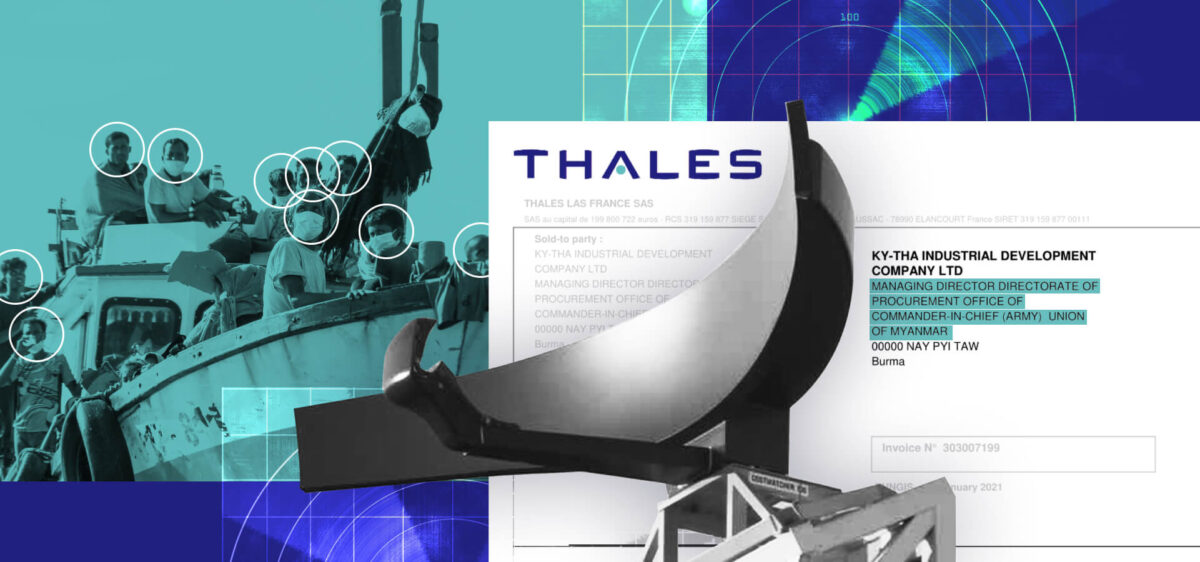
Arms giant Thales, in which the French state is a shareholder, has sold to the Burmese forces six radars used for monitoring its coast, Disclose and Info Birmanie can reveal. The surveillance systems, which were delivered between 2017 and 2020 in spite of an EU embargo, may be used to crack down on civilians, including the Muslim Rohingya minority who have been persecuted by the ruling junta.
What is Thales playing at in Myanmar? The French arms group has supplied high-tech surveillance equipment to the country led by bloodthirsty military authorities. The reconnaissance radars can trace maritime and coastal activity in the west of the country. The radar, called Coast Watcher 100 and assembled in Ymare, near Rouen, is able to “detect and follow up to 1,000 targets, even in difficult conditions,” the manufacturer pledges, by providing “24/7 coastal surveillance”.
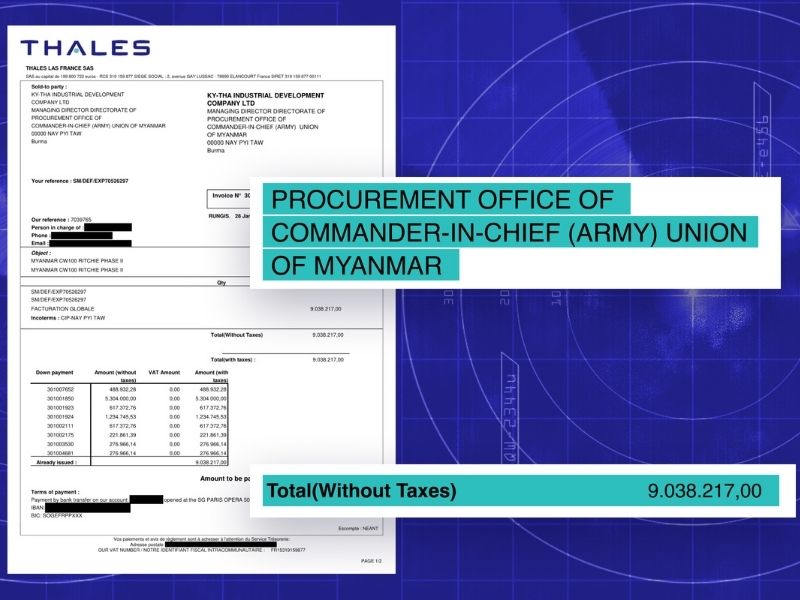
According to internal documents seen by Disclose and Paris-based NGO Info Birmanie, Thales delivered six Coast Watcher 100 radars to the Myanmar junta between 2017 and 2020 for 16 million euros.
Until now, the details of the deal with the junta remained secret. Yet it raises several serious issues regarding respect for international law by Thales and the French state, which has a 26% stake in the arms company. Myanmar has indeed been under an EU embargo since 2013. It prohibits EU companies from exporting equipment “that could be used for cracking down” on government critics but also on the Rohingya Muslim minority. The embargo was extended in 2018: no goods that could be used for military or civilian purposes may be exported to the country if “the end users are the military or border guards”.
The six Coast Watcher 100 radars were ordered by the Myanmar armed forces. In other words, Thales may have been guilty of violating the EU embargo. The French arms manufacturer told us that they have “always strictly complied with all regulations pertaining to (…) international sanctions against Myanmar”. Regarding the identity of the buyer, the French firm justifies the sale by arguing that “Coast Watcher radars are not military equipment and [that they] have been designed for coastal protection”.
In Myanmar, “coastal protection” is a major concern. Officially, the junta monitors its coast to combat terrorism and piracy as well as unregulated fishing and illegal immigration. But for several years media outlets and NGOs in Rakhine state, where the Rohingya are from originally, have been documenting attacks on local civilians and fishers. In December 2025, for instance, 28 Muslim fishermen were detained by the armed forces. A few weeks later, during the night of 25 January 2026, three fishing boats came under fire. The military apprehended ten seamen who say they were subjected to acts of torture. Two days later, the Myanmar Navy arrested six fishers from the region, all Muslims.
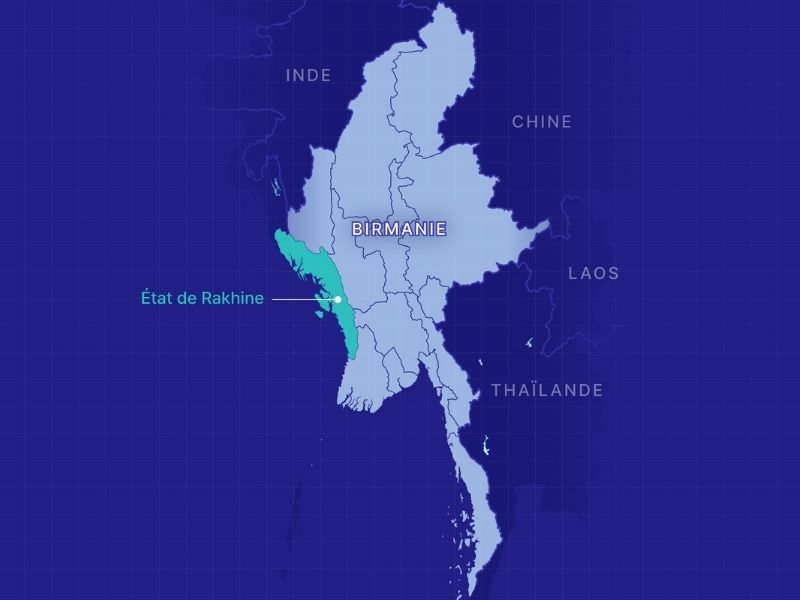
According to a report by NGO Burmese Rohingya Organisation UK, harrassment by the military aims to starve people and prevent them from fleeing. “Rohingya fleeing Rakhine state may be detained by the Myanmar Navy or arrested on land,” the authors say. They add that internally displaced people are “held and arbitrarily sentenced” and that “children are separated from their mothers and sent to detention centres for minors.” Regarding incoming traffic, “boats are checked to prevent food consignments from getting in,” says a former officer who defected in 2024 and joined armed rebel groups. Rakhine state faced imminent famine in 2025.
“Supplying these radars may be a violation of the embargo”
Matilda Ferey, lawyer specialising in international criminal law
In these circumstances, does saying that “Coast Watcher radars are not military equipment” justify selling them to the Burmese regime? The manufacturer argues that it does. “Coast Watcher 100 radars are neither war equipment nor goods treated as military. They are designed for civilian use but with specific features which mean that export licences are required.” The French Armed forces and Economics ministries which, according to Thales, granted such licenses, did not return our request for comment.
Disclose checked with three lawyers specialising in international criminal law. All say that these contracts with the army, even for allegedly “civilian” use, are problematic. “No one can be certain that the Burmese junta is not using these radars to crack down on legitimate internal resistance,” says Matilda Ferey. She adds that “supplying these radars may therefore be a violation of the embargo”.
“Continue to negotiate and make progress on the contract”
The flourishing relationship between Thales and the Burmese military began when a first contract was signed on 9 March 2015. A second agreement was reached on 10 February 2016 and the first three Coast Watcher 100 radars were delivered the following year.
In August 2017, the crackdown on the Rohingya minority reached a significant point, with thousands of people being killed and more than 700,000 forced to flee to Bangladesh. But the violence did not end the relationship between the French company and Myanmar’s armed forces. An official Burmese document that NGO Justice for Myanmar provided to Disclose reveals that a meeting took place between Thales representatives and Burmese Navy top officials on 15 September 2017. On the agenda: “meeting to discuss the implementation of the contract”. The procurement department wished to “continue to negotiate and make progress on the Coast Watcher 100 contract”. The Thales management would not comment on the secret meeting.
What we do know is that the arms group reached out again to the Burmese authorities in early 2021 to request payment of a last invoice for nine million euros. It was handled by the office of the man who had just come to power following a coup, General Min Aung Hlaing. He was accused in 2024 by the prosecutor of the International Criminal Court (ICC) of acts of deportation and persecution in the country. The deal paid off. By selling Coast Watcher 100 radars for 16 million euros, Thales generated healthy margins, between 30% and 40%, according to internal documents, or a profit of six million euros.
The matchmaker
From the start of its negotiations with the junta, the multinational relied on a partner who proved both discreet and influential, the Ky Tha company, owned by the Kyaw Thaung family. The Kyaw Thaung clan, said to be close to the authorities, is believed to be key in “helping the Burmese army avoid western checks on exports,” according to a New York Times investigation. The CEO of the company, Jonathan Kyaw Thaung, is also reported to supply arms to the junta himself, according to the government in exile. As for the family holding overseeing Ky Tha, it has allegedly acted as a go-between for the purchase by the junta of transport aircraft imported from the EU.
Disclose and Info Birmanie have traced an astonishing photograph taken in June 2016 at the Eurosatory arms fair in Villepinte, near Paris, four months after the second secret contract was signed. The owner and senior manager of Ky Tha, Moe Kyaw Thaung, can be seen together with the Burmese ambassador and the junta’s second in command, General Soe Win. Just behind them stands a man in a flying suit, one of the two westerners in the picture. His name is Thierry Poignant.
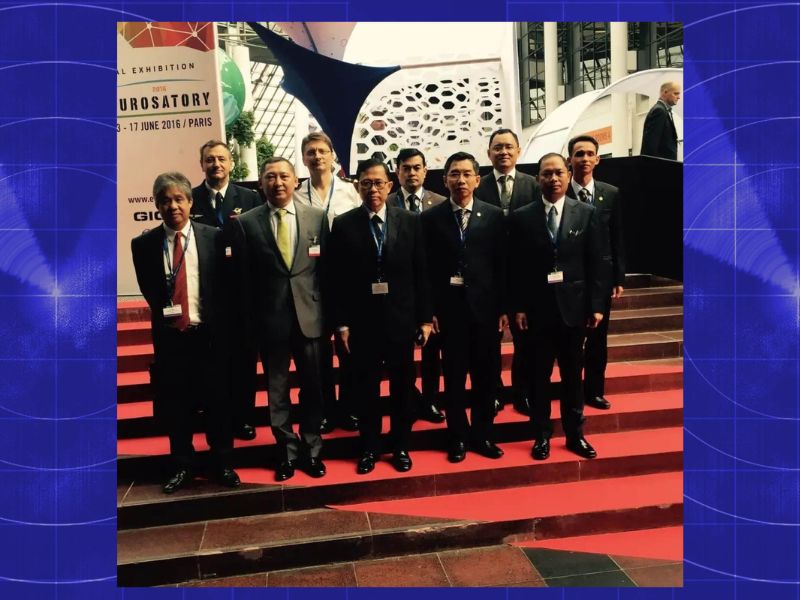
Thierry Poignant, in the top left corner, when he was employed by the French Embassy in Myanmar – he now works for Thales. Front row, from left to right: Moe Kyaw Thaung, who heads the Ky Tha company; Han Thu, Myanmar’s ambassador to France; Soe Win, the junta’s second in command; Ko Ko Lwin, the incumbent energy minister; and U Tin Maung Swe, the Burmese ambassador to China.
At the time, he was in charge of political analysis and strategy at the French Embassy in Myanmar. Thierry Poignant did not return our request for comment on his attendance in Villepinte together with Burmese dignitaries. The French national was catapulted as director of international development at Ky Tha two months after the arms fair, according to an archived version of his LinkedIn profile. He stayed more than a year with the company before ending up with Thales, in September 2018, as director of international development. Was he recruited by the group to follow up on the Burmese contract and rely on his network within the military apparatus? “No,” says the manufacturer. Thales adds that Poignant is not “in charge of Myanmar” and that “his role within the group solely involves work on development and future strategy”.
What now? Thales could be sued for failing to comply with EU sanctions against Myanmar. If the embargo is found to have been violated, the management of the group headed since 2014 by Patrice Caine are liable to a term of five years’ imprisonment.But this is unlikely as only the Ministry of economics and finance, currently run by Roland Lescure, may apply to a court and launch customs infringement proceedings against the company. “It is up to member states to implement and enforce EU sanctions,” according to the EU Commission.
International justice is the alternative. In January, the Burmese authorities faced charges of genocide before the International Criminal Court in The Hague. The ICC is expected to deliver its verdict by the end of this year. The accountability relates to the Burmese state only since private individuals cannot be tried, but this could trigger more suits against the junta’s leaders and supporters. Thales should be on the list, says Tun Khin, the chair of an NGO fighting for the rights of the Rohingya, Burmese Rohingya Organisation UK. If the radars “help the Burmese army to identify targets,” then they “are as deadly as the guns firing at these targets,” says Tun Khin. He adds that “the Rohingya community, who live on the coast, have been forced to flee for decades and are in danger, even at sea”. He says the prosecutor of the International Criminal Court should open an investigation for possible “complicity in genocide against the Rohingya”.
Investigation: Johanna Chardonnieras (Info Birmanie) and Ariane Lavrilleux
Editing: Mathias Destal and Diane Chaker Sultani
Fact-checking: Rémi Labed
Translation from French: Béatrice Murail
Composite: Eric Delfosse
This investigation is free of charge, thanks to you
Because information is a public good, Disclose offers you all its investigations free of charge, without subscription or advertising. This model is unique in France for an investigative news outlet.
But it’s only possible on one condition: that readers like you support our not-for-profit newsroom. Donations to Disclose are eligible for a 66% tax reduction in France. So a donation of €100 will only cost you €34. Thank you for your support!

On the same topic

French arms
Read the collectionRead also
Moldovan affair: revelations about a far-reaching corruption system within Interpol
A vast corruption network made it possible to exploit Interpol’s shortcomings in order to remove red notices against at least 28 alleged criminals. The former chairperson of Interpol’s oversight body – the Commission for the Control of Files (CCF) – and the organisation’s bureau in Moldova were at the heart of the system. Despite warnings, it has taken years for Interpol to respond, Disclose can reveal on the basis of exclusive documents.
Interpol turning blind eye to persecution by Tajik dictatorship
With close to 3,500 red notices in circulation, Tajikistan is among the three countries sending the highest number of wanted requests to Interpol. Under the pretext of fighting terrorism, the Tajik dictatorship has been using the police organisation to hunt down political opponents and Muslim citizens with no links to armed organisations. Although its rules have been repeatedly violated, Interpol has not taken action.