Predicting migration flows with artificial intelligence – the European Union’s risky gamble
Predicting migration flows with artificial intelligence – the European Union’s risky gamble
For several months the European Union has been developing artificial intelligence software that supposedly predicts migration flows in order to improve the way migrants are dealt with when they arrive on European soil. Yet according to several documents obtained by Disclose, the tool called ‘ITFLOWS’ could quickly become a formidable weapon for controlling and harassing people seeking refuge in Europe.
It is software that would not look out of place in some fictional dystopian world. An artificial intelligence capable of compiling thousands of pieces of data in order to predict migration flows and identify the risks of tensions over the arrival of migrants at Europe’s borders. It is called ‘ITFLOWS’ which stands for ‘IT tools and methods for managing migration flows’. Funded to the tune of five million euros by the European Union and developed by a consortium made up of research institutes, a private company (Terracom) and charities, ITFLOWS is currently being tested and is due to enter service in August 2023. This is despite repeated warnings that its predictive capabilities could end up being misused to control and restrict the rights of refugees on European soil.
Still largely unknown, this programme is due to complete a technical system aimed at monitoring the EU’s borders, in particular those in Spain, Italy and Greece. Funded by the EU’s ‘Horizon 2020’ research and innovation programme, ITFLOWS will takes its place alongside the use of autonomous surveillance drones, lie detectors in border transit zones and software to extract mobile phone data.
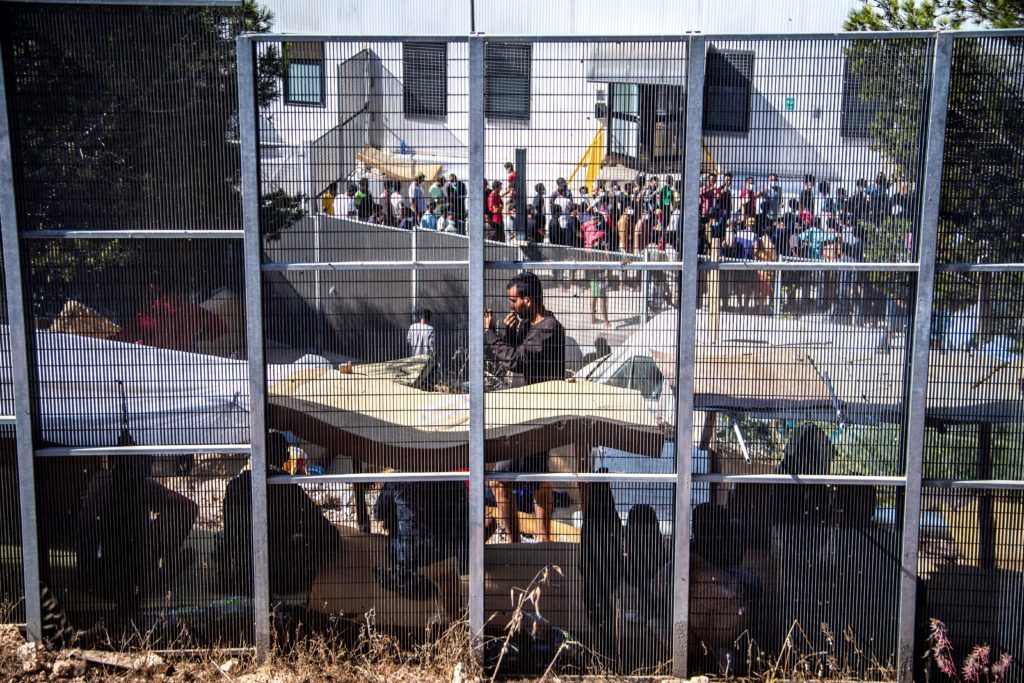
According to our investigation, charities Red Cross and Oxfam are helping to supply important information for the software used by ITFLOWS. This data comes directly from interviews carried out in migrant camps with Nigerian, Malian, Eritrean and Sudanese refugees. This information could, for example, be about the ethnic origins, sexual orientation or religion of those interviewed. The Italian branches of the Red Cross and Oxfam have received 167,000 euros and 116,000 euros respectively from European public funds for their help.
©Alessandro Serrano/AFP
“We have contributed by carrying out 30 interviews of migrants who have arrived in Italy over the last six years,” confirmed the Italian Red Cross when asked by Disclose. Once analysed and then made accessible via an app called ‘EUMigraTool’, this information will be used by the Italian authorities in their analysis of the “migration routes and the reasons that drive people to make the journey” added the charity. Oxfam Italy had a similar message, acknowledging the usefulness of the data for “political leaders of the countries most exposed to migration flows“. These leaders could also make use of an analysis of the political risks associated with the arrival of migrants on their territory. In fact, the project includes the potential to study pubic opinion in certain European countries by monitoring Twitter.
Alarming internal reports
In reality the risks that the programme could be misused are very real. That is revealed in internal consortium reports that Disclose obtained following a request for access to administrative documents. These two reports, dating from January and June 2021, were written by members of the ethical board at the ITFLOWS project, and their conclusions are alarming. The first document, which runs to 225 pages, reveals that the “ITFLOWS consortium is fully aware of the risks and their potential impacts in terms of jeopardising human rights that both empirical migration research activities and technological developments foreseen in the Project may pose“. Later in the report the authors drive the point home. According to them the information provided by the algorithm “may pose several risks if misused for stigmatising, discriminating, harassing, or intimidating individuals, especially those that are in vulnerable situations such as migrants, refugees and asylum seekers“.
Your donation helps us to remain independent
Support usFive months later the ethical board delivered a second report. It set out the risks in a little more detail: “Member States may use the data provided to create ghettos of migrants“; “discrimination on grounds of sexuality, race, religion, disability, age“; “the risk that migrants and asylum seekers may be identified and sanctioned for irregularities“. The report also warns of another danger: “The risks of reinforcing fear and arguments against migration, or the increasing hate speech in areas where the inhabitants are informed that the inflows will move...”
“These documents were draft versions, and not final European Commission approved versions. They were not and are not to be public as they were only draft versions“, Itflows reacted in a letter sent to Disclose a few days after the publication of our article.
Europe turns a deaf ear
These warnings appear not to have been heeded. This is shown in an assessment given during an online symposium held on September 16th 2021 by a member of the ITFLOWS ethical board, Alexandra Xanthaki, to senior figures in Europe including Zsuzsanna Felkai Janssen from the directorate-general for migration and home affairs at the European Commission. “We spent six months working day and night to create a report about the human rights framework“, says Xanthaki, according to a recording obtained by Disclose. “And now it seems to me that what the tech members are saying is: we’re not taking it into account. So what’s the point in having it in the project?“
Concern over this lack of precaution goes further. Contacted by Disclose, Alexander Kjærum, a senior analyst at the Danish Refugee Council (DRC), who also sits on the users board at ITFLOWS – the board contains people with practical experience of dealing with migrants and refugees – said that “here’s a big risk that information gets into the hands of states or governments that will not use it to enhance support and protection for these vulnerable groups, but will use it to throw up more barbed wire“.
Contacted by Disclose, ITFLOWS coordinator Cristina Blasi Casagran insisted that the software would not be “misused“. According to her, ITFLOWS should even help the entry of migrants into the EU by enabling a “better allocation of the resources” used to deal with them when they arrive.
Frontex’s close interest raises concerns
One final factor increases the risk that the software might be misused: and that is the keen interest shown by border agency Frontex in ITFLOWS. According to internal documents the EU’s border and coastguard body has followed the programmes development closely. Frontex has even actively contributed by supplying the project with data collected in the course of its work. Yet in recent years the agency has regularly been accused of carrying out illegal expulsions and committing violations of human rights.
Questioned about this, Oxfam considered there was no risk the software could be misused to help the border agency. The Italian branch of Red Cross meanwhile said that the “grant agreement determining the implementation of the ITFLOWS project does not name Frontex as a user of the tool, but simply as a source of open data”. In 2021 Frontex highlighted ITFLOWS as one of the Horizon 2020 projects that had the most operational and innovative “potential”.
Zach Campbell and Lorenzo D’Agostino
Updated on August 2, 2022, with a link to the response to Disclose by Itflows.