The death of Zineb Redouane: the evidence that accuses the police
The death of Zineb Redouane: the evidence that accuses the police
Disclose and Forensic Architecture have investigated the circumstances of the firing of a police teargas grenade in Marseille that hit 80-year-old Zineb Redouane who died 24 hours later on December 2nd 2018. The conclusions of this joint investigation engage the responsibility of the police for her death.
On March 19th 2019, the investigation into the death of Zineb Redouane was in its early stages. The then French interior minister, Christophe Castaner, interviewed that morning by Nicolas Demorand on public radio station France Inter, presented what would become the official line. “I wouldn’t want people to be led to believe that the forces of law and order killed Zineb Redouane, because that’s untrue,” said Castaner, adding: “There must be a stop to talk about police violence.”
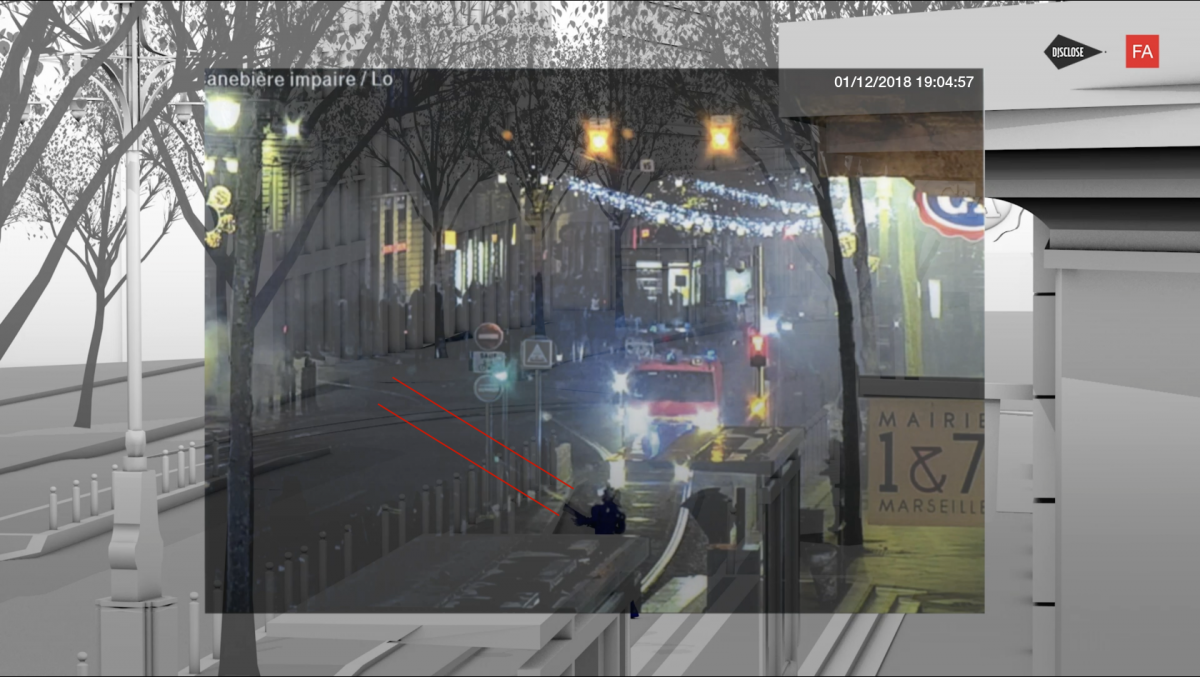
In a reconstruction using information from hitherto confidential documents and the creation of a 3D model of the sequence of events, this joint project between Disclose and Forensic Architecture demonstrates the responsibility of the police in the death of 80-year-old Zineb Redouane in Marseille in 2018, after she was hit in the face by a teargas grenade which also spilled its gas into her apartment.
Zineb Redouane died at the Conception hospital in Marseille at 10.20pm on December 2nd 2018, the day after she was hit by the teargas grenade that was fired, on the sidelines of an anti-government ‘yellow vest’ demonstration, at a speed of 97.2 kilometres per hour (60.3 mph). In May this year, a new document was added to the ongoing investigation into her death. This was a ballistics report commissioned to establish whether proper respect for regulations had been observed when the grenade was fired. The conclusions of the report were to exonerate the still-unidentified person who fired the grenade.
Public interest
The report was written by a senior member of the police forensic science services based in the city of Lyon, and a forensic pathologist with the Lyon 1 University. The conclusions they came to were based on the “different calculations and measurements” carried out inside Zineb Redouane’s apartment, where she was hit, and the street outside. Using that data, the experts drew up an approximate calculation of the angle of the grenade launcher at the moment it was fired, which they estimated at “between 30 and 45 degrees”. On the basis of that, the experts concluded that “the weapon was used according to the recommendations and procedures for its usage in place at the Police Nationale”.
The investigation by Disclose and Forensic Architecture firmly contradicts the conclusions of the ballistics report and brings into question the line of defence maintained over the past two years by senior management of France’s national police force.
In the name of the public interest, and for those who wish to compare the thoroughness of our research against the official experts’ findings, Disclose has made available online the complete contents of the ballistics report currently in the case file.
Disclose
On the same topic