The Zineb Redouane case, a symbol of police impunity
The Zineb Redouane case, a symbol of police impunity
Since the opening in December 2018 in France of a judicial investigation into the circumstances of the death of 80-year-old Zineb Redouane, the police officer at the centre of the case has still not been identified. We reveal how the probe was obstructed.
Since the opening two years ago, on December 4th 2018, of a judicial (judge-led) investigation tasked with “researching the cause of death” of Zineb Redouane in Marseille, the police officer who wounded her with a grenade as she closed her shutters above a street demonstration and sent vast volumes of teargas into her apartment on December 1st 2018 has still not been identified.
However, an inquiry by the Marseille branch of the French police internal investigation department, the Inspection générale de la police nationale (IGPN), very quickly determined the exact time when the teargas grenade that hit Zineb Redouane in the face was fired, the type of grenade launcher used – a Cougar – and also identified the CRS riot police unit that was present at the time of the events.
Of the 70 CRS officers sent to Marseille from their base in the east-central town of Saint-Etienne to maintain order during a third day of action by ‘yellow vest’ anti-government protestors on December 1st 2018, only five were armed with Cougar teargas grenade launchers.
The IGPN investigation, which finally came to nothing, did not study images from social media but only the videos from four CCTV cameras.

According to the IGPN report, three of the four CCTV cameras were angled such that they only showed “the general atmosphere” and not the moment the grenade was fired, while the camera which most certainly would have allowed the identification of the CRS officer who fired the grenade in question was, the IGPN investigators wrote, “not working” that day.
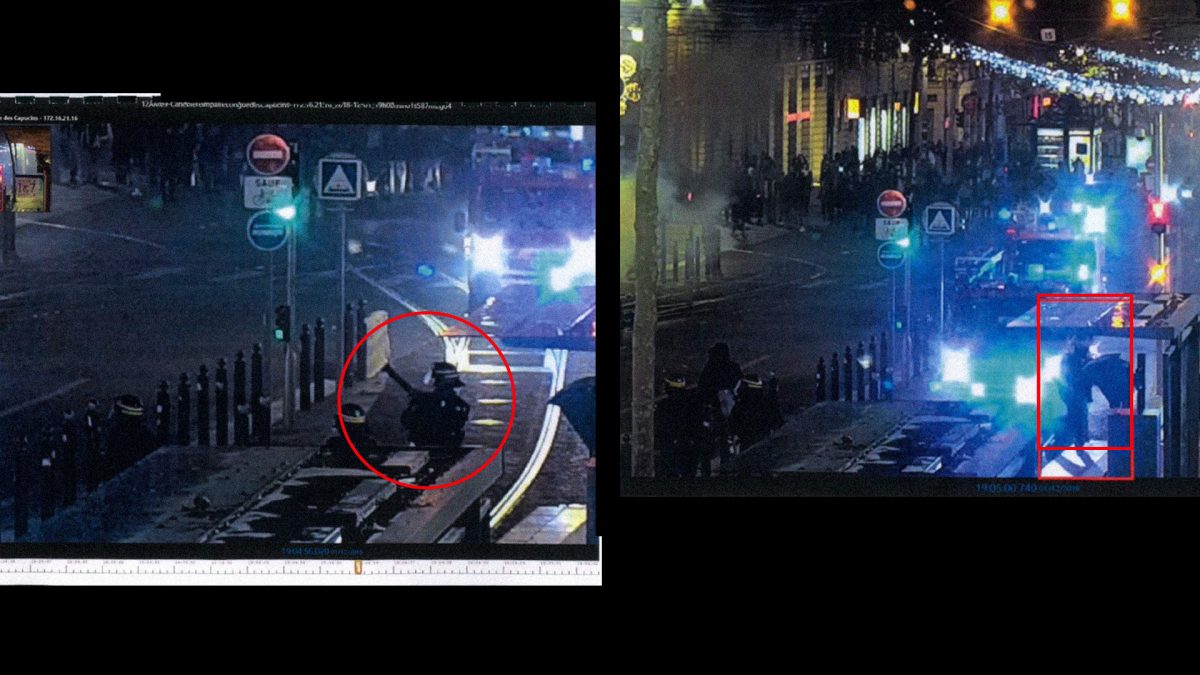
Another CCTV camera recorded the events from a lengthy distance. On December 6th 2018, an IGPN officer transferred the images from this to the captain in charge of the CRS unit from Saint-Etienne so that he might recognise the person who fired the Cougar. The captain, who was present at the scene of the events in the early evening of December 1st, was also asked to submit for inspection the five grenade launchers used that day, in order to establish which one was used in the shot that seriously wounded Zineb Redouane, and who fired it.
Sabotage of the investigation
A reply came back the next morning. “After having consulted all of the hierarchical chain [of command] and the personnel concerned, it is not possible for me to identify the officer given the quality and distance of the images,” wrote the CRS captain, who refused to hand over the Cougar weapons. His refusal was, he said, in order “to not compromise the operational capacity of the unit during this intense period of protest movements“.
In June 2019, the lawyer representing Milfet Redouane, the daughter of Zineb Redouane, filed a complaint for falsification and removal of evidence in the case. In the complaint, seen by Disclose, the lawyer, Yassine Bouzrou, underlined that “the Cougar launchers used on December 1st 2018 constitute elements of proof that are indispensable in establishing the truth”.
Any refusal to provide the Cougars to the investigation was, he argued, to impede the search for proof and the prosecution of those guilty.
It was on January 25th 2019, more than seven weeks after the death of Zineb Redouane, that the five CRS officers who were carrying grenade launchers in Marseille on the fateful day were finally questioned by one of their IGPN police colleagues.
“Are you the shooter who appears on the screen ?” the IGPN officer asked one of the CRS policemen. “I don’t recognise myself in this scene and I don’t recognise the colleague either“, was the reply.
Asked the same question, another of the CRS officers replied : “It could be me, or not. I have no certainty whatever.” A third answered : “Despite the distance, one can see that the [officer firing the Cougar] is not wearing a balaclava under his helmet, and I am very clear that I was wearing my balaclava and [protective] glasses that evening.” The remaining two others proved to be of no better help in identifying the person who fired the grenade that hit Zineb Redouane.
The police officer in charge of the CRS unit under scrutiny, and who has the grade of police “commander”, was also questioned on January 25th 2019. In his statement, he said: “There was no ‘incident’ of firing. It was well shot. It’s the destination that is unfortunate.” When he was shown the images from camera 4, the one at a distance, he said that the shot complied with regulations, with the angle of the Cougar held at between 30° and 45°. “On the video, one can see that it was a curved-trajectory shot“, he said. “One sees that the situation appears lively around them, which justifies the shot in question.“
Red alert
His deputy, the captain who refused to hand over the grenade launchers to the investigation, was also questioned, when he told the IGPN that the five CRS officers armed with the Cougars were acting under his “direct authority”. But he said that at the moment the grenade in question was fired, he “noticed nothing“.
“I sometimes found myself around 50 metres away from last [grenade] shooter in the unit”, he said. Commenting the CCTV images, he said : “On the basis of this video, I can see that [they] are under attack from the left and they are responding with the Cougar and hand grenades.”
Six months later, the captain was awarded the “internal security” medal for his “exceptional commitment” within the French national police force.
The last witness who was questioned by the Marseille branch of the IGPN was a ballistics expert from the police forensic science services who was one of two forensic experts commissioned on December. “At this stage of the experts’ report, and without having the results of tests, the consultation of the video does not appear to show irregularities in the use of the Cougar launcher“, he said in his statement. That was also the final conclusion of the report by him and a forensic pathologist that they submitted, one and a half years later, to the judicial investigation into the cause of Zineb Redouane’s death.
The ballistics expert, just like, before him, the CRS unit head and his deputy, did not mention the existence of a key document, namely an official internal French interior ministry guidelines about “the use of grenade launchers” provided to the national police and gendarmerie services.
Dated 2017, that four-page document, obtained by Disclose, precisely details the conditions by which these “intermediary-force weapons” may be used, or not. In its introduction, it sets out that, “Neither conceived nor destined to kill“, grenade launchers “nevertheless remain weapons whose potential danger should not be underestimated, notably regarding the effects produced by the grenades that they serve to propel“. In a chapter entitled “Precautions for use“, it is underlined that use of the grenade launchers “can only be proceeded upon orders from the hierarchy” and that their use is “subordinated to the presence” of a supervisor. According to these instructions from the interior ministry, it is incumbent upon the supervisor to warn the operator of the grenade launcher “about the environmental conditions that are susceptible to render the firing [of the grenades] ineffective or dangerous”.
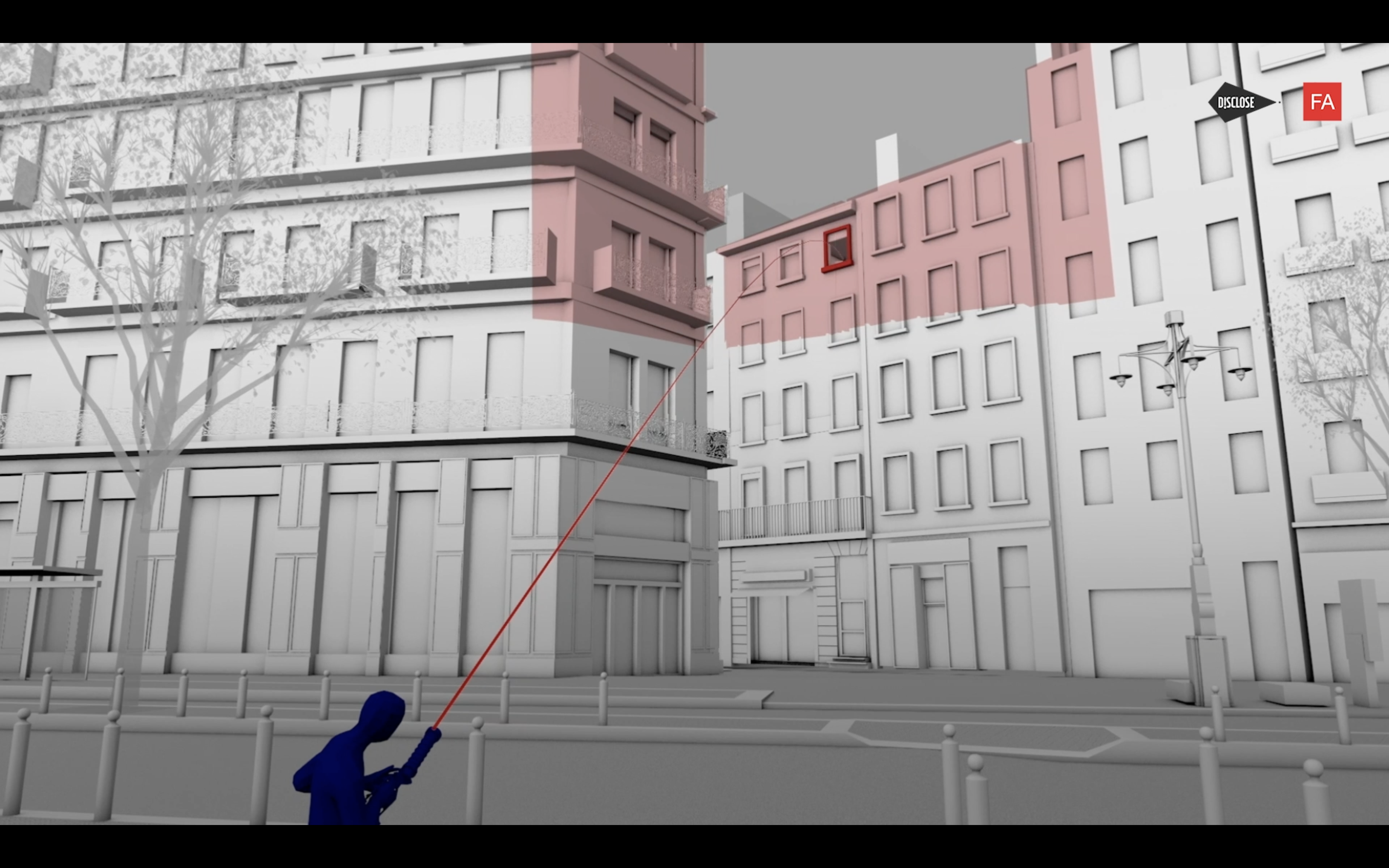
Viewed from the position of the CRS officer at the moment he was to fire the grenade, the presence of several buildings that were situated directly in front of him should have at least represented a red alert. Especially given that the ammunition used, an MP7 grenade, is normally used to reach a target at a distance of 100 metres. But at the moment of the firing of the grenade that hit Zineb Redouane, the building in which her apartment was situated was less than 40 metres away.
Failing requirements to target “an operational objective”
The video-assisted investigation here by Disclose and Forensic Architecture reveals another disturbing element concerning the attitude of the CRS officer who launched the grenade which hit the 80-year-old woman. After launching the grenade, he stepped backwards to let a vehicle pass before raising his eyes in the direction of his line of fire. Twelve seconds later, he was still looking in the same direction before leaving the scene in the company of several of his colleagues.
The instructions on the use of the grenade launcher insists that it “must allow to hit an operational objective while respecting the conditions of necessity and proportionality”. These also set out that “all situations in which this weapon is used […] should systematically be the subject of a detailed account”. Therefore, it is incumbent upon both the operator of the grenade launcher and his supervisor to observe the trajectory of the grenade and the subsequent effects. In the case of that which hit Zineb Redouane in the face, the grenade immediately disappeared inside her apartment.
The CCTV images do not allow for a precise reconstitution of the vision of the CRS officer when he was looking up at the line of fire. But one thing is certain: he followed the line of fire and its failure “to hit an operational objective”. When, added to that, he left the scene just a few moments after the launching of the grenade, it appears probable that the police officer and his colleagues were the first to realise that they had committed a grave wrongdoing.
The initial official investigation opened into Zineb Redouane’s death, formally termed as an investigation into the “voluntary violence that led to the unintentional death […] by a person of public authority” became tainted by suspicion of collusion between the Marseille public prosecution services and members of the police. As a result, the judicial investigation was handed to a magistrate in Lyon. He has still to pronounce his conclusions on whether the launching of the grenade was operated according to official regulations, and upon the eventual responsibilities of the CRS officers for the death of Zineb Redouane.
Mathias Destal
On the same topic