Decathlon: revelations on a champion of exploitation
Making innovative garments that are hard-wearing and above all affordable: this is Decathlon’s recipe for success. However, confidential documents obtained by Disclose tell a very different story about the sports retail giant. Child labour, exploited Uyghur workers in China, connections with deforestation in Brazil, etc.: our revelations show that the multinational is prepared to do anything to maximise profits.
Behind iconic products – the 2 Seconds tent, the 3-euro Quechua back pack and the Easybreath snorkeling mask – is a name that goes hand in hand with innovation: Decathlon. The French brand has made its resourcefulness into an emblem. It boasts design centres close to the Alps, on the Atlantic coast and near Lille, in the Nord department, where it started off in 1976 in a small warehouse by a dual carriageway. Nearly fifty years later, it has won the hearts of consumers and has been one of the most popular brands in France for several years.
This performance almost overshadows the fact that Decathlon is first and foremost a money-making machine which opens a new store somewhere in the world every four days. Its turnover has doubled over ten years, reaching 15.6 billion euros in 2023 – a net profit of 931 million euros. It was such an achivement that the company, which is unlisted, paid dividends totalling 1 billion euros to its majority shareholder, the Mulliez family, who also own Leroy Merlin, Auchan and Kiabi. This was done at the expense of store employees, according to Decathlon trade unions who called a strike in December 2024, a one-off in the brand’s history. The company is rarely the subject of controversy but its image was tarnished in late 2023 when Disclose revealed that it was still selling its products in Russia through companies domiciled in tax havens. The “love of sport” proclaimed by the brand seemed to be dwarfed by greed, and this is confirmed by a new three-part investigation.
Over one year, Disclose looked deep into the French multinational’s trade secrets. We analysed dozens of internal documents, collected exclusive testimonies from former members of staff and worked with independent researchers. Our investigation has uncovered the serious human and ecological consequences of Decathlon’s “low cost” strategy.
Paltry wages in Bangladesh, child labour and trafficking in human beings in China: our investigation reveals that Decathlon’s main suppliers in Asia resort to several forms of modern slavery. These outrageous production conditions are the consequence of cost pressure imposed by the French brand on its subcontractors. To save more money, Decathlon’s partners also include factories which get their leather supplies from cattle retail giants who are accused of being primarily responsible for illegal deforestation in Brazil.
On the fast fashion bandwagon
Although the brand has invested millions not to be typecast as a “low cost” brand, the two words are ubiquitous in internal documents that an internal source shared with Disclose. Low prices are what drives the brand to have most of its garments made by subcontractors. Decathlon has 1,264 subcontractors around the world and only nine production sites of its own. For maximum profitability, the manufacturer looks first and foremost for the cheapest factories, namely those “working for low-price brands involved in mass production,” according to an internal document listing subcontractor selection criteria. One would have thought that such an aggressive commercial strategy was the preserve of Chinese fast fashion giants such as Shein and Temu.
Its main suppliers are in Asia: in order of importance, in China, Vietnam and Bangladesh. The latter is actually described as a “low cost country” in an internal roadmap. Making garments in the country — where more than half the population live in slums — is a “strength” for Decathlon, according to the same document. In Bangladesh, the group works with suppliers described as “extremely low cost”. They employ adolescents who may legally be paid less than the minimum wage. Other factories in its production chain in the country are described as “clandestine” by a former member of staff. Although they supply up to 10% of the components of a shoe, the brand conducts no audits there, Disclose can reveal in the first part of its investigation.
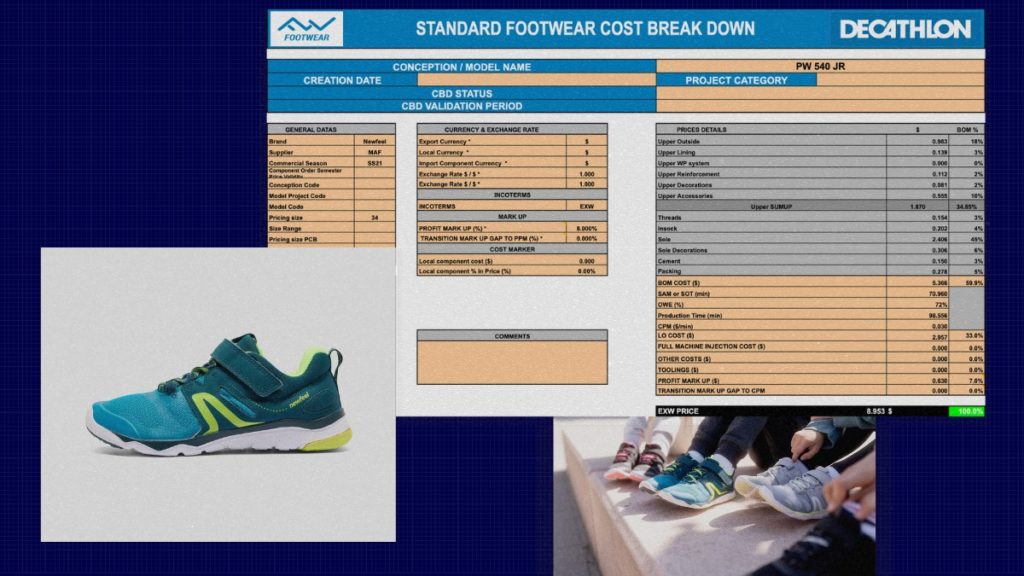
At the end of the chain, the workers making Quechua, Kipsta, Domyos and Kalenji products pay the price for the Decathlon system. Disclose has obtained an internal bill of materials detailing the production cost of very popular children’s shoes, the Decathlon PW 540. Making a pair costs 8.61 euros in Bangladesh and workers earn only 2.84 euros. A pair retails for 25 euros in France.
A champion of exploitation
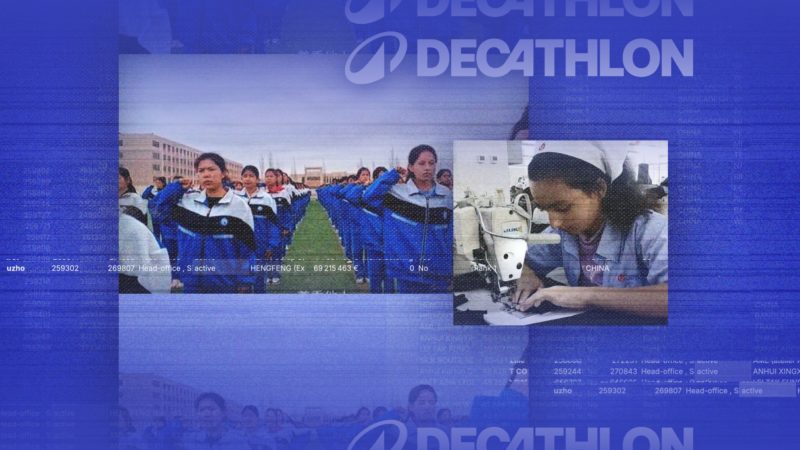
The thirst for profit also lured Decathlon into the arms of other problematic subcontractors in China. The second part of our investigation, published on Thursday 6 February, in partnership with Cash Investigation, reveals that one of its main local partners resorts to the forced labour of Uyghurs, a Muslim minority persecuted by Beijing. Our undercover investigation in two Chinese factories also reveals that Decathlon uses cotton from Xinjiang, the Uyghur home region, where forced labour accusations are rife.
Our investigation on the multinational with 931 million euros profit in 2023 also took us to Brazil. The third part, published in partnership with Dutch media outlet Follow the Money on Saturday 8 February, looks into the origin of another raw material: the leather that is used to make the famous Quechua walking boots. The factories that assemble them in Vietnam use cattle hides from Brazil at the risk of contributing to eradication of primary forests in the country.
Commenting on our revelations, Decathlon simply declared its “commitment to responsible procurement”. The company added that it “strongly condemns all forms of forced labour and child labour”. Yet its quest for the lowest prices contradicts these commitments. It belies the founder of the brand, Michel Leclerq, who used to say: “Deceiving customers is strictly forbidden at Decathlon”.
Read the other episodes of our investigation “Decathlon, a champion of exploitation”:
- Decathlon’s Quechua shoes manufactured by suppliers linked to deforestation in Brazil
- Decathlon profits from Uyghur forced labour in China
- Decathlon, the hard labour textile factory in Bangladesh
Investigation: Pierre Leibovici
Editing: Mathias Destal
Translation from French: Béatrice Murail
On the same topic

Decathlon, a champion of exploitation
Read the collectionRead also
Decathlon profits from Uyghur forced labour in China
A 12-year-old girl, workers from the Uyghur minority forced to make clothes, etc.: one of Decathlon’s main suppliers relies on a network of forced labour in China, as revealed by Disclose in partnership with Cash Investigation. The French brand’s clothing also contains cotton from the Xinjiang region which is under international sanctions.
Decathlon, the hard labour textile factory in Bangladesh
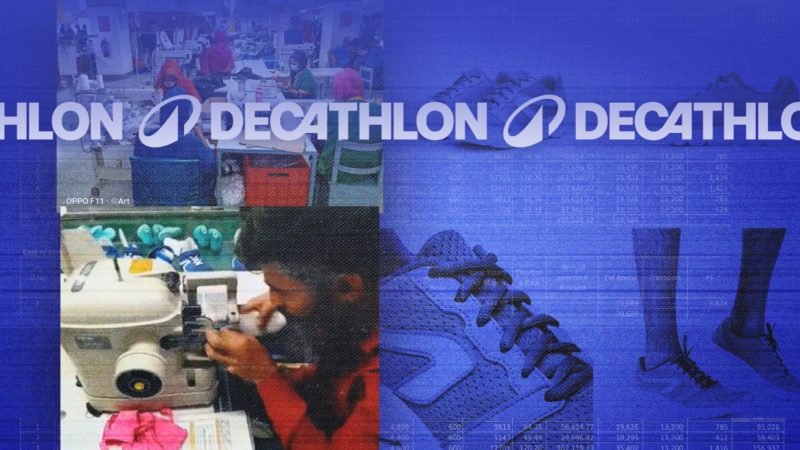
To offer the lowest possible prices, the French giant sports retailer has its garments made in one of the poorest countries in South Asia. There, Decathlon selects the subcontractors who pay the lowest wages, even if that means working with clandestine factories that are dangerous for employees, Disclose can reveal on the basis of confidential documents.
Decathlon’s “secret project” to keep doing business in Russia
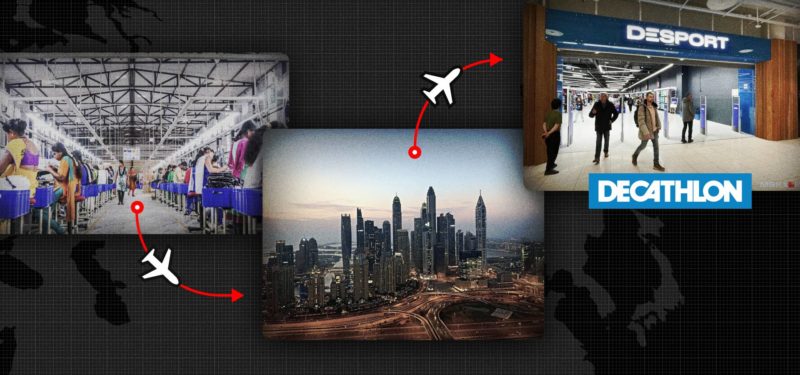
A shell company in Dubai and a subsidiary in Singapore: French sports retail giant Decathlon has set up an opaque system to continue selling its products in Russia, although it announced its departure from the country. Internal documents seen by Disclose reveal that the multinational has pocketed at least $12m thanks to this secret contract.