Revelations on the misuse of Interpol by the world’s most repressive regimes
Revelations on the misuse of Interpol by the world’s most repressive regimes
The mission of the prestigious criminal police institution, to fight organised crime, is being misused on a large scale for the benefit of some of the world’s most repressive states, Disclose and the BBC can reveal after thousands of internal Interpol documents were leaked. We expose abuse including persecution, secret manhunts and arbitrary arrests, part of a system where Interpol’s red notices have become a powerful weapon for countries like Russia, Turkey and Tajikistan.
The agency, set up more than 100 years ago, is depicted in films as the elite of world police. Interpol, the famous criminal police organisation, enables its 196 member countries to join forces to fight terrorism, human and drug trafficking as well as cyber crime on an international scale. Interpol has made it possible to arrest war criminals Radovan Karadzic and Ratko Mladic, convicted for their role in the Srebrenica genocide in Bosnia, and some of the world’s notorious cocaine dealers, including Rocco Morabito, the leader of the Calabrian Ndrangheta. The arrests, which have been widely praised, contribute to “a safer world,” according to Interpol’s communications department, but the organisation is also vulnerable to the widespread misuse of its police capacities. Interpol has for years enabled the persecution of a fast increasing number of political dissidents, activists, journalists and members of ethnic and religious minorities pursued around the world. The abuse of power has jeopardised the lives of hundreds of targeted people, and the organisation has been fully aware of this. For the past ten years it has claimed to address the issue. In vain.
Internal Interpol documents including confidential reports, correspondance between national bureaus, detailed charts showing notices in circulation and the names of issuing countries and memos from supervisory authorities, have been leaked to Disclose and to the BBC, which is unprecedented. The leak uncovers an international scandal at the heart of Interpol, where the system has turned a reputable police force into a powerful weapon of political repression. Its flaws are staggering, starting with the fraudulent use of “red notices,” the famous police requests enabling a state to share a wanted notice with all the other member states of the organisation.
The control of Moscow
Every year, thousands of red notices are published without the people concerned being informed. Many of them discover it at the airport or during a police check which can lead to their arrest, including in democratic countries. Not surprising: less than 10% of the 86,000 red notices currently in circulation are public. This figure was sent to us by the Interpol communications department, in response to a long series of questions. But it refuses to make public the names of the countries which issued them. However, as Charlie Magri, who spent six years at Interpol before becoming a lawyer specializing in red notice abuse, explains, “without detailed country specific data, Interpol’s statistics offer only a shallow view” of its functioning and use by member countries.
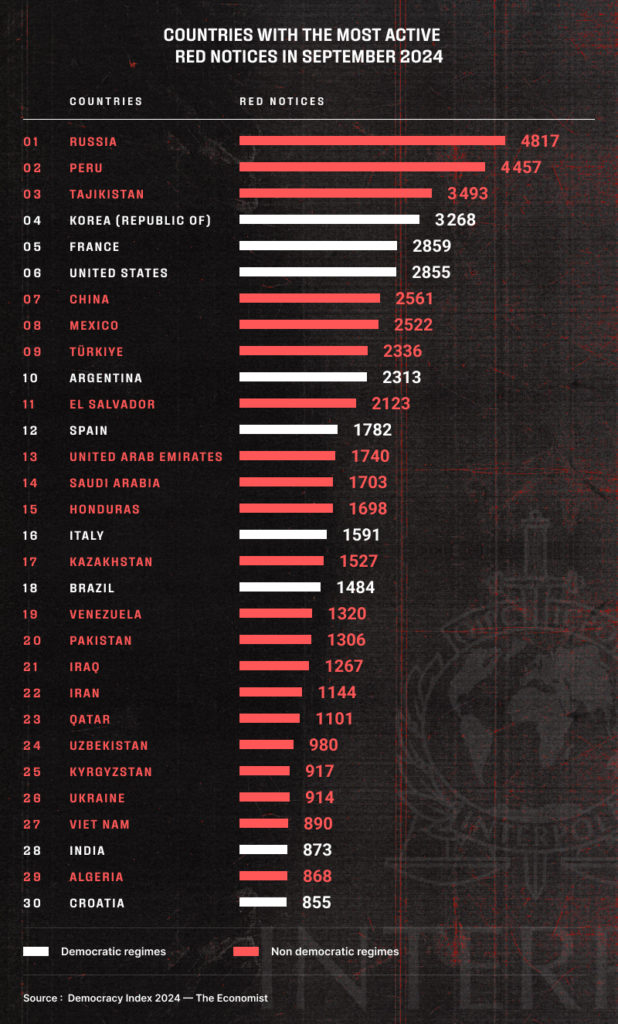
Our investigation discloses the ranking of the countries that submit the highest number of red notices internationally. In late September 2024, Russia, led by Vladimir Putin, was well ahead. Twenty other non democratic states featured among the top 30 countries on the list, including some of the world’s most repressive regimes.
The tens of thousands of wanted notices are checked twice by Interpol, before they are issued, and afterwards by the Commission for the Control of Files (CCF) if the targeted persons lodge a complaint. These safeguards are in place to make sure notices for mutual police assistance are in line with the organisation’s Constitution. Article 3 states that “it is strictly forbidden for the Organization to undertake any intervention or activities of a political, military, religious or racial character.” In other words, officers must revoke the notice if the institution’s political neutrality is violated.
The CCF has acknowledged that the number of applications for deletion has increased fivefold over 10 years. In 2024 alone, at least 322 people who complained that the notices issued against them were unjustified obtained the removal of their file by the Commission for the Control of Files. The figure does not include all those who could not afford a lawyer to challenge the red notices but it says a lot about the point addressed here. The departments that make sure Interpol is used appropriately are overwhelmed and under pressure.
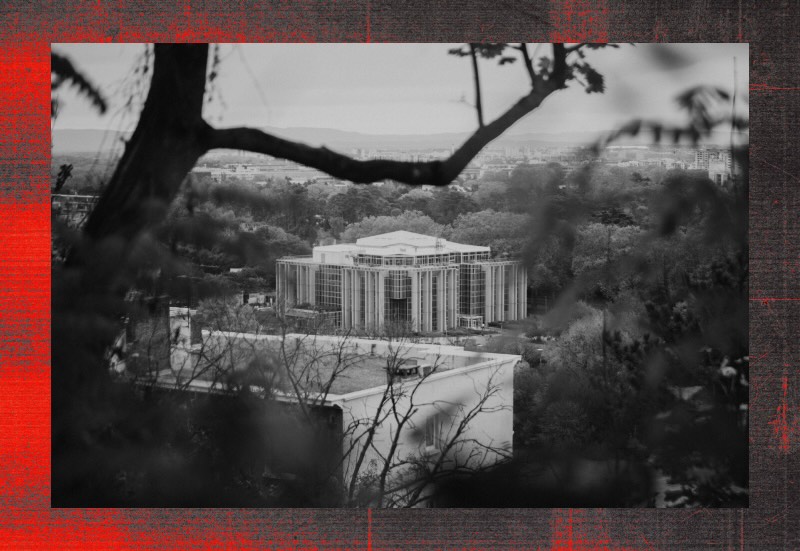
Interpol’s Moscow bureau also tops the list for submitting an increasing number of abusive red notices, more than any other bureau. Our estimates indicate that many of the complaints are lodged by people in Russia who feel red notices issued against them are unfair. The CCF often vindicates them. According to internal Interpol reports seen by Disclose, out of 194 files linked to Russia and reviewed by the Commission in 2024, close to 50% failed to meet Interpol’s standards.
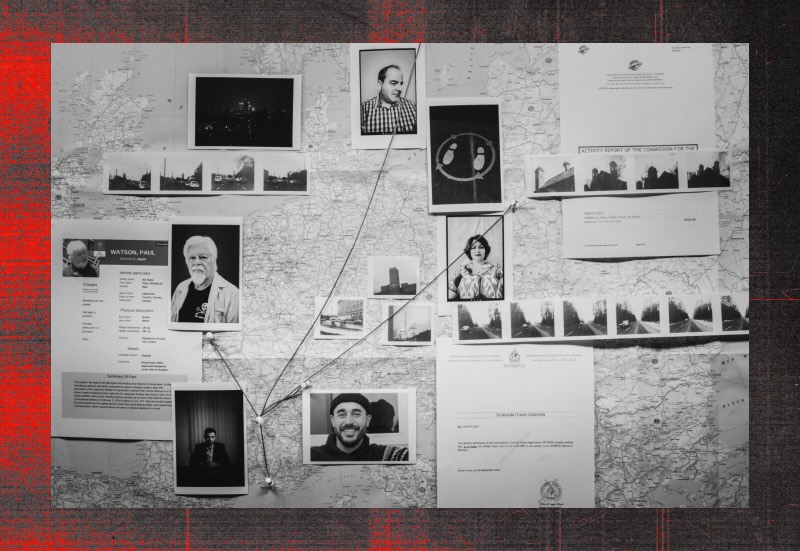
Russia is not the only authoritarian regime weaponising the police agency. China, ranked seventh among countries issuing red notices, also hounds political dissidents and members of the Uighur minority with the red notice system, as reported in several media investigations. But other serious cases are not as widely known, including Tajikistan, ranked third. Our investigation reveals that the Tajik regime, which has been led for more than 30 years by autocrat Emomali Rahmon, uses Interpol to track down dissidents on the basis of bogus terrorism claims (lien vers enquête). Turkey, ranked ninth, is also problematic. According to a confidential memo from Interpol’s general secretariat dated January 2025, “Ankara’s requests continue to be a challenge”. The authors of the memo stress that “the percentage of non-compliant files remains higher than in most countries”.
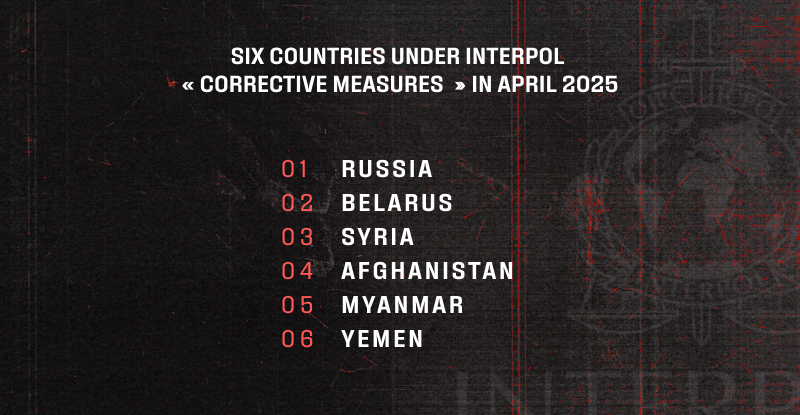
Despite Ankara’s repeated misuse, Turkey has not been hit by any “corrective measure,” a device for enhanced checks of the use of notices and of some Interpol databases by countries deemed problematic. In April 2025, six countries were monitored closely, including Russia, Belarus and Syria, according to a memo intended for Interpol’s Executive Committee.
Interpol has been aware for more than a decade of the risk of police files being misused. In 2016, the organisation’s general secretariat even funded the establishment of a special unit, the Notices and Diffusions Task Force (NDTF) to scrutinise notices both before validation and after issuance. In 2024, the NDTF made it possible to identify 2,462 non-compliant red Notice and Diffusion files. This is better than nothing, although removals often come too late. “Interpol has brought its redress mechanism from what it was before, I would call from the Stone Age to the Middle Ages and kind of left it there,” says Yuriy Nemets, a lawyer in Washington who specialises in the removal of Interpol notices. “And it doesn’t seem like it is planning on improving the situation.”
Environmental activist Paul Watson has been a victim of this situation. He had to wait 13 years for the red notice Japan issued against him to be deleted. Misuse by democracies is rare but it does happen. In June 2025, the organisation eventually acknowledged “the political elements” in the proceedings launched in 2012 by Tokyo, which has pursued Watson because of his activism against whaling. “I haven’t been back to my home country, Canada, since 2012,” he told Disclose. “I missed the funeral of my brother, I missed the funerals of my best friends because of Interpol,” said the activist, 74, who spent five months in prison in Greenland in 2024, narrowly avoiding extradition to Japan.

The misuse of Interpol’s missions is all the more alarming since the states committing the abuse are not content with flooding police forces around the world with bogus red notices. They also try to take advantage of the organisation’s other shortcomings, as revealed by the documents we have seen.
For instance, Russia uses an instant messaging tool that makes it possible for police forces to interact live with Interpol’s other national bureaus to try to locate political dissidents fast. As for Belarus, which has been under enhanced surveillance as a result of all too frequent abuse, it has obtained access to databases that are monitored less than red notices. Witness the arrest of Veronika Tsepkalo, a human rights activist and opposition figure to Alexander Lukashenko’s regime. On 29 August 2024, as she was about to cross by car the border between Albania and Greece, she was arrested by police and her car was seized. It had been reported to Interpol as a stolen vehicle. Nearly two months after the ruse was exposed, the organisation removed 83 vehicles linked to Belarus from its stolen vehicle file.
Given Russia’s repeated abuse, one might think that the organisation has taken more binding measures, but quite the contrary. According to our information, Interpol recently reduced checks on Moscow and lifted the corrective measures introduced after the invasion of Ukraine in 2022. Interpol has not responded to requests for comment, seemingly preferring to maintain opacity rather than engage in transparency.
Investigation and data: Mathieu Martinière, Robert Schmidt and Rémi Labed, with the BBC
Editorial coordination: Mathias Destal, with Ariane Lavrilleux
Fact-checking: Rémi Labed
Editing: Élodie Emery
Photos: Nicolas Serve
Infographics: Éric Delfosse
Cover image: Éric Delfosse, with Nicolas Serve
Translation from French: Béatrice Murail
This investigation is free of charge, thanks to you
Because information is a public good, Disclose offers you all its investigations free of charge, without subscription or advertising. This model is unique in France for an investigative news outlet.
But it’s only possible on one condition: that readers like you support our not-for-profit newsroom. Donations to Disclose are eligible for a 66% tax reduction in France. So a donation of €100 will only cost you €34. Thank you for your support!


On the same topic